


Evidence Mounts for Hierarchical Black Hole Mergers
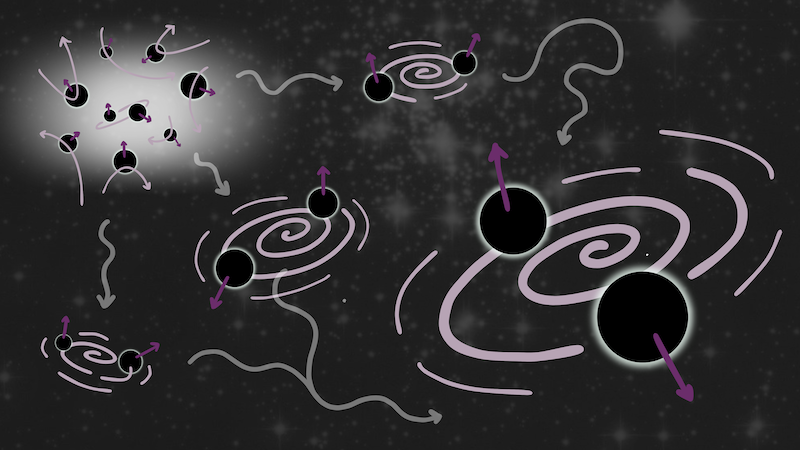

Throughout the Universe, pairs of orbiting black holes emit ripples in spacetime that propagate across the cosmos. These gravitational waves carry away orbital energy, causing the black holes to slowly spiral closer together. This process is extremely slow, but, in a minority of cases, it leads to a cataclysmic merger within the age of the Universe. Since the historic detection of gravitational waves in 2015 (see Viewpoint: The First Sounds of Merging Black Holes), the LIGO, Virgo, and KAGRA gravitational-wave detectors have advanced to the point of recording a signal from merging black holes every few days of operation, yielding a cumulative catalog of hundreds [1]. Understanding how, when, and where the Universe produces these extreme astrophysical collisions remains an open question, with implications spanning physical scales from the subatomic to the cosmological.
Now, two teams led, respectively, by Cailin Plunkett at MIT [2] and Sharan Banagiri at Monash University in Australia [3] present evidence that a subset of binary black hole observations can be connected to a particular origin story: that of hierarchical mergers, in which at least one member of the pair is not the remnant of a dead star but instead the product of an earlier black hole merger (Fig. 1). The fact that these and other analyses [4–10], based on markedly different assumptions, converge on a similar conclusion strengthens the case that hierarchical mergers constitute an important contribution to the binary black hole population.
Compared with planets, stars, galaxies, and other celestial bodies, black holes are—according to general relativity—remarkably simple, characterized entirely by their mass and intrinsic angular momentum (“spin”). Yet identifying the pathways through which two such objects end up in a merging binary is a far more complicated puzzle. Broadly, these formation pathways can be sorted by whether the duo began orbiting before or after becoming black holes. The former case is governed by classical stellar evolution, which predicts that the most massive stars will eventually collapse into black holes; if processes such as accretion have sufficiently tightened the orbit of a stellar binary, the stars’ black hole remnants may end up close enough to merge within cosmic timescales. In the scenario that doesn’t involve a preexisting stellar binary, the two black holes instead find each other later in life, pairing up through dynamical gravitational encounters in dense, chaotic astrophysical environments, such as globular clusters or the disks of active galactic nuclei.
Each formation pathway should leave a distinct imprint on the masses and spins of merging black holes. Population inference seeks to uncover these signatures by analyzing gravitational-wave detections collectively and connecting the emerging patterns to underlying astrophysical mechanisms. So far, the data have revealed mergers involving black holes ranging from roughly 3 to 300 times the mass of our Sun, with spin axes pointing in a wide range of directions and mostly small spin magnitudes—features that are consistent with contributions from multiple formation channels [11]. The next challenge for the field is to move beyond this broad-brush description and identify distinct parts of the population associated with different formation pathways. Progress on this line of inquiry remains complicated because of large uncertainties in our models of stellar evolution [12].
Hierarchical mergers make up one hypothesized subpopulation: While most observations are consistent with two “first-generation” black holes formed directly from stellar collapse, dynamic environments can produce binaries containing at least one “second-generation” component that is the remnant of an earlier merger. Hierarchical mergers are of particular interest for two complementary reasons. First, they have profound astrophysical implications, such as explaining how black holes can be produced in a theorized “mass gap” left by pair-instability supernovae and how stellar-mass black holes can act as seeds that grow into the supermassive black holes that power galaxies. Second, hierarchical mergers are relatively straightforward to model. Since their description does not hinge on the complex physics of dying stars, theory and simulations yield robust mass and spin predictions [13]. Specifically, second-generation black holes should be about twice as massive as their first-generation partners, while their spin axes should point in random directions and their spin magnitudes should cluster around 0.7 times the maximum value allowed by general relativity [14]. The observation of binary black holes with large, unequal masses and/or spins clustered around this telltale value would provide compelling evidence of hierarchical mergers.
Searching for hierarchical mergers in the gravitational-wave catalog requires adopting a population model. Plunkett and collaborators develop an astrophysically motivated model involving two spin subpopulations, one of which is designed to capture the expected features of hierarchical mergers [2]. Rather than relying on spin magnitudes and directions, which often are poorly constrained, the researchers focus on better-measured parameters called the effective inspiral spin and the effective precessing spin. Such parameters capture the components of black hole spin that are, respectively, parallel and perpendicular to the orbital angular momentum. While previous work used the effective inspiral spin alone to infer the hierarchical merger fraction [4, 5], Plunkett and collaborators are the first to incorporate spin-precession information, arguing it is needed for a reliable comparison between theoretical predictions and observations [13, 15]. Their analysis suggests that, within the fourth Gravitational Wave Transient Catalog (GWTC-4.0), more than half of the detections involving one black hole heavier than 40 solar masses belong to a hierarchical subpopulation. These high-mass binaries have spins clustered near 0.66 times the maximum value from general relativity—which is consistent, within measurement uncertainty, with the 0.7 prediction. Support for a hierarchical-merger subpopulation has also recently emerged from similar astrophysically motivated analyses based on spin magnitudes and directions rather than effective spins (Fig. 2) [6–8].
Meanwhile, Banagiri and collaborators take a more agnostic approach to identifying subpopulations [3]. Rather than explicitly modeling particular astrophysical formation channels, they allow a binary’s mass ratio, spins, and distance from Earth to vary and let the data determine how many distinct subpopulations are required. Using this framework, they find three distinct binary black hole subpopulations in GWTC-4.0, the heaviest of which emerges as the natural candidate for hierarchical mergers: It contains binaries involving black holes above roughly 40 solar masses preferentially paired with companions half as heavy. In contrast to lower-mass subpopulations, whose spins are preferentially small, the spins of this high-mass group have a nearly flat distribution between 0 and 1, encompassing the 0.7 value. Banagiri and collaborators caution, however, that the high-mass subpopulation may not be entirely hierarchical, as they did not find spin clustering at the characteristic value nor a transition in spin orientation. Despite differing on the inferred spin properties, both studies identify a high-mass subpopulation involving highly spinning black holes, suggesting that this feature is robust to markedly different modeling assumptions.

The search for observable signatures of hierarchical black hole mergers has become a major focus of gravitational-wave astronomy—one that highlights the value of approaching the same problem with different modeling philosophies. Indeed, a wide range of studies analyzing GWTC-4.0 now point to a transition around 40–45 solar masses, above which the binary black hole population isn’t predominantly characterized by small spins [2–10] (Fig. 2). This conclusion, emerging across a wide range of models, is highly consistent with theoretical predictions for hierarchical mergers. As gravitational-wave detectors continue to improve, they will become increasingly sensitive to high-mass binaries, providing sharper insights into the role of hierarchical mergers in shaping the observed population.
References
- LIGO Scientific Collaboration, Virgo Collaboration, KAGRA Collaboration, “GWTC-5.0: Observations from the second part of the fourth LIGO-Virgo-KAGRA observing run and updates to the Gravitational-Wave Transient Catalog,” arXiv:2605.27225.
- C. Plunkett et al., “Signatures of a subpopulation of hierarchical mergers in the GWTC-4 gravitational-wave dataset,” Phys. Rev. Lett. 137, 021404 (2026).
- S. Banagiri et al., “Evidence for three subpopulations of merging binary black holes at different primary masses,” Phys. Rev. Lett. 137, 021403 (2026).
- F. Antonini et al., “Gravitational-wave constraints on the pair-instability mass gap and nuclear burning in massive stars,” Nat. Astron. (2026).
- H. Tong et al., “A subpopulation of low-mass, spinning black holes: signatures of dynamical assembly,” arXiv:2511.05316.
- A. M. Farah et al., “The steep redshift evolution of the hierarchical binary black hole merger rate may cause the z- correlation,” Astrophys. J., Lett. 1001, L40 (2026).
- A. Vijaykumar et al., “The maximum mass ratio of hierarchical binary black hole mergers may cause the q- correlation,” Astrophys. J., Lett. 999, L30 (2026).
- A. Hussain et al., “Evidence for mass-dependent spin subpopulations in GWTC-4,” arXiv:2605.24281v1.
- A. Q. Cheng et al., “Reversible-jump MCMC reveals binary black hole subpopulations with distinct redshift evolution,” arXiv:2605.259800193/v1.
- S. Galaudage, “Compactness peaks and subpopulations: Probing stellar physics and formation channels of merging binary black holes,” arXiv:2605.25994.
- LIGO Scientific Collaboration, Virgo Collaboration, KAGRA Collaboration, “GWTC-5.0: Population properties of merging compact binaries,” arXiv:2605.27226.
- I. Mandel and F. S. Broekgaarden, “Rates of compact object coalescences,” Living Rev. Relativ. 25, 1 (2022).
- K. Kremer et al., “Modeling dense star clusters in the Milky Way and beyond with the CMC cluster catalog,” Astrophys. J., Suppl. Ser. 247, 48 (2020).
- C. O. Lousto et al., “Remnant masses, spins and recoils from the merger of generic black hole binaries,” Class. Quantum Grav. 27, 114006 (2010).
- E. Payne et al., “Spin doctors: How to diagnose a hierarchical merger origin,” Astrophys. J., Lett. 966, L16 (2024).