


Plans for Moon-Based Gravitational-Wave Detectors Get a Lift from Geology
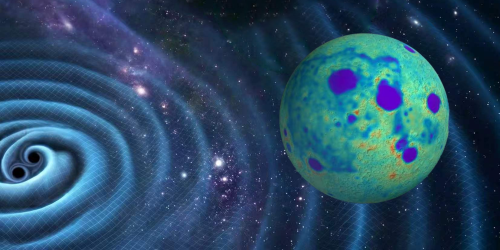

The Moon—like any massive object—should jiggle when a gravitational wave passes by. Scientists have proposed searching for such gravitational-wave responses by placing seismometers on the Moon’s surface. A new study led by Lei Zhang from China’s Institute of Geology and Geophysics suggests that the signal may be stronger than expected, especially in regions on the farside of the Moon where the crust is relatively thick [1].
Gravitational waves can generate seismic waves in Earth and other bodies, but the signal is typically drowned out by vibrations from volatile weather patterns, sloshing oceans, and plate tectonics. Lacking those confounding sources, the Moon is seismically quieter.
The Lunar Gravitational-Wave Antenna (LGWA) is one of several projects proposed to study seismic waves on the Moon. LGWA would be an array of seismometers sensitive to gravitational-wave signatures at decihertz frequencies (0.1 Hz), whereas LIGO and other observatories are most sensitive to gravitational waves at around 100 Hz. Previous studies estimated the lunar signal—in terms of vibration amplitude—to be around 10–13 m, which is conceivably detectable. However, those studies assumed a uniform, spherically symmetric Moon.
Zhang and colleagues have developed a more realistic lunar model. Using satellite maps that record both topography and gravity variations, the researchers estimated the crustal thickness across the lunar surface. They plugged this model into simulations and computed the response to a passing gravitational wave. The results showed that the seismic signal should be 10% stronger on average than previous estimates. Moreover, thick-crust regions, such as the farside highlands, could magnify the signal by 10 times, with clear implications for the choice of seismometer locations, the researchers say.
Besides detecting gravitational waves, future lunar missions could also probe the geological structure of the Moon. In a separate study, Han Yan of Peking University (who is a member of Zhang’s team) and Jan Harms of the Gran Sasso Science Institute in Italy envision coupling an LGWA-like project with other gravitational-wave observatories on Earth or in space [2]. They determined that comparing signals from the different detectors would offer information about the internal makeup of the Moon, which could resolve questions about the formation history of our satellite, the researchers say.
–Michael Schirber
Michael Schirber is a Corresponding Editor for Physics Magazine based in Lyon, France.
References
- L. Zhang et al., “Thick lunar crust amplifies deci-hertz gravitational-wave signals,” Phys. Rev. Lett. 137, 021408 (2026).
- H. Yan and J. Harms, “Gravitational-wave tomography of the Moon: Constraining lunar structure with calibrated gravitational waves,” Phys. Rev. Lett. 137, 021409 (2026).