


Lab-Based Plasmas Shed Light on Stellar Mystery


Some of the most iconic images of the Sun have captured the explosive force of coronal mass ejections (CMEs), in which huge clouds of magnetized plasma erupt from the solar atmosphere. But CMEs have only rarely been sighted on other stars, a discrepancy that has puzzled astrophysicists for many years. Now an international research team has devised an experiment that recreates these stellar eruptions in the lab, providing clear evidence that CMEs can be suppressed by strong magnetic fields [1]. The same experimental approach could also be used to investigate the role that magnetic confinement plays in other stellar activity.
CMEs from the Sun are generated when the solar magnetic field becomes twisted and unstable. Under these conditions a sudden release of magnetic energy can expel huge plumes of plasma into space, with the effects felt on Earth through geomagnetic storms, spectacular auroras, and occasional disruptions to electronic systems. Astrophysicists have searched for the signs of CMEs on nearby stars, but the few candidate events that have been identified were much weaker than expected, given the data on solar CMEs.
Researchers have speculated that the differences in CME activity are caused by differences in stellar magnetic fields. The stars that have been targeted by CME searches are typically young, nearby stars that rotate at high speeds, generating magnetic fields some 10 to 100 times stronger than that of the Sun. Previous simulations have indicated that such strong magnetic fields could prevent CMEs from escaping the star [2], but there has been no direct evidence to support the theory.
A team led by astrophysicist Julian Alvarado-Gómez of the Leibniz Institute for Astrophysics Potsdam in Germany and plasma physicist Julien Fuchs at the École Polytechnique in France devised an experiment that recreates the conditions under which a CME is launched from a star into space. Using facilities at the Laboratory for the Use of Intense Lasers (LULI) in France, the team fired laser pulses at a flat target made from Teflon. Each pulse generated a hot plasma stream of ionized Teflon molecules flowing away from the target. To emulate the stellar magnetic field, a pair of wire coils inside the target chamber produced a strong magnetic field in the transverse direction to the plasma flow. This background field compressed the plasma stream into a flat, outward-moving sheet.
The researchers set the values for certain physical quantities—such as the ratio of magnetic pressure to plasma pressure—to be similar to those in astrophysical settings, thus ensuring that their laboratory system evolved in the same way as a stellar CME. They then observed the effects of increasing the magnetic-field strength. At a magnetic field of 10 tesla (T), the plasma flowed without impediment over the timescale of the experiment. When the field reached 30 T, there was a clear transition: The flow started to bend and split, and it then stopped entirely after traveling about 10 mm. The plasma flow also became significantly slower, which is consistent with observations of the weak CMEs observed around nearby stars.
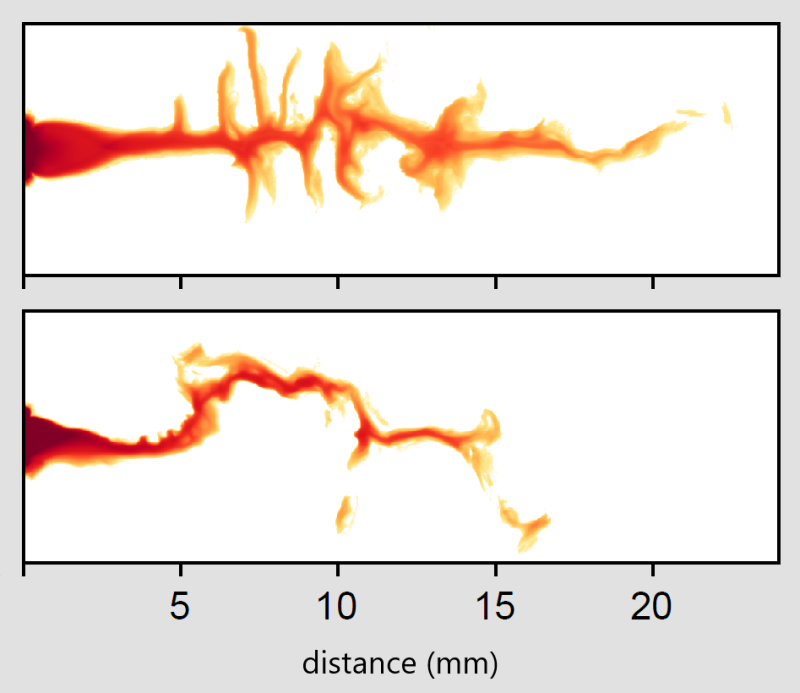
To understand the physical mechanisms behind this behavior, the team replicated the experimental observations using an established numerical model. At high magnetic fields, the model revealed kink-like instabilities in the lab-based plasma flow. These instabilities cause the plasma flow to break up into multiple streamlets and eventually die away.
The results are consistent with astrophysical simulations, which show that magnetic fields above a certain threshold can prevent CMEs of a particular energy from escaping their host star. Extrapolating the lab results to the astrophysical scale suggests that for typical CME energies this threshold is about 100 gauss (0.01 T), which would be normal for a young star.
Astrophysicist Eric Blackman of the University of Rochester in New York says that the results validate theoretical predictions for the effects of a background magnetic field on a plasma flow with fixed energy and momentum. But he points out that real-star environments are complicated, with flows and fields affecting each other. “There is an opportunity for further work to study what happens in possibly more realistic cases in which the strength of a CME is correlated with the strength of the background field,” he says.
More generally, the ability to couple such strong magnetic fields to an expanding plasma offers new opportunities to study the stellar environment. “A laboratory experiment can shine light on processes that are extremely difficult, or even impossible, to measure with telescopes,” Alvarado-Gómez says. For example, astrophysical simulations have suggested that the stellar corona produces high-energy electromagnetic radiation when the CME is confined, a prediction that Alvarado-Gómez hopes to test in the lab.
–Susan Curtis
Susan Curtis is a freelance science writer based in Bristol, UK.
References
- S. N. Chen et al., “Experimental evidence for coronal mass ejection suppression in strong stellar magnetic fields,” Phys. Rev. Lett. 137, 105201 (2026).
- J. D. Alvarado-Gómez et al., “Suppression of coronal mass ejections in active stars by an overlying large-scale magnetic field: A numerical study,” Astrophys. J. 862, 93 (2018).