


Nonreciprocity Sends Flocks into Chaos

Imagine two children playing tag in a large playground. One chases while the other runs away. Because their goals are incompatible—one wants to close the distance between them, while the other wants to increase it—they can become locked in a long, exasperating pursuit. Frustrated dynamics of this kind often produce interesting spatiotemporal patterns. A game of tag, for example, may settle into a circular chase that persists, at least until one of the players runs out of breath.
Over the past few decades, physicists have realized that similar scenarios are widespread in some living systems where self-propelled agents do not respond to one another in the same way—that is, where the agents’ interactions are nonreciprocal [1–5]. For example, a hawk may pursue a dove while the dove flees. But if predators and prey are in flocks, how does nonreciprocity affect their collective order? Now three teams of theorists have made progress on this question [6–8]. Working independently, they investigated two-species variants of the Vicsek model, a widely used statistical-mechanical framework for studying the collective motion of active matter. The three flocking studies demonstrate how nonreciprocal interactions at the microscopic level can qualitatively transform order at the macroscopic level. Meanwhile, similar behavior was found experimentally in a population of starfish embryos of two different ages [9].
Physicist Tamás Vicsek introduced this model in 1995 to understand how large groups of birds and other self-propelled agents can develop coordinated motion. It describes particles that move at a fixed speed while tending to align their directions of motion with those of nearby particles. A remarkable feature of the model is that these particles can flock while maintaining orientational order over arbitrarily long distances, even in two dimensions [10, 11]. This result contrasts sharply with the behavior of a mathematically similar system: equilibrium magnets at finite temperature. Here, spins with short-range interactions cannot develop true long-range order in two dimensions. Vicsek flocking has become a canonical example of how nonequilibrium dynamics can produce forms of order that are forbidden in equilibrium.
The three teams of theorists investigated whether and how the robustness of the order in the Vicsek model survives the introduction of nonreciprocal interactions. In their models, particles within each of two species, A and B, tend to align with one another. However, thanks to their nonreciprocal interactions, species A tries to align with species B, while species B tries to antialign with species A. These incompatible tendencies set the entire flock into rotation, with the average direction of motion turning steadily either clockwise or counterclockwise. The direction of rotation arose spontaneously, raising another question: Can a sufficiently large system select a single chirality and maintain coherent rotation throughout the flock? All three teams arrived at the same answer: It cannot. At sufficiently large scales, nonreciprocal flocking gives way to spatiotemporal chaos.
In their paper, Chul-Ung Woo of Saarland University in Germany and his colleagues characterized how this chaotic state emerges [6]. They found that the number of unstable degrees of freedom grows in proportion to the system’s area—a phenomenon known as extensive chaos: A larger flock is not merely as unpredictable as a smaller one but proportionally more so. They also identified the length scale at which coherent rotation breaks down. The rotating state survives only when the system is smaller than a characteristic scale set by the radius of the circular trajectories traced by the particles.
Charlotte Myin of the Max Planck Institute for Dynamics and Self-Organization in Germany and her colleagues identified the physical mechanism behind this breakdown [7]. They found that the globally rotating state is destroyed by the proliferation of topological defects. These defects act as persistent sources of disorder, repeatedly generating expanding regions of disrupted motion that erode global coherence. Local chiral order can nevertheless survive on length scales shorter than the typical distance between defects.
Aditya Kumar Dutta of the Indian Association for the Cultivation of Science and his colleagues reached a closely related conclusion by systematically exploring the model’s parameter space [8]. They found that coherent chiral motion occupies only a narrow region: The flock must be dense, the particles must move slowly, and the system must not become much larger than the interaction length. In their model, global rotation is therefore a finite-size phenomenon that requires carefully chosen conditions rather than a generic state of nonreciprocal flocks.
A rotating flock can be viewed as a spatially extended oscillator: Each region cycles through different directions of motion, and global rotation requires these local oscillations to remain phase coherent. Remarkably, an abstract version of this phenomenon was studied more than three decades ago, long before “nonreciprocal active matter” had a name. In 1993, physicist Geoffrey Grinstein and his colleagues asked a question: Under what conditions can a noisy, spatially extended system oscillate coherently [12]? Their answer relied on an unexpected analogy. One can assign a phase to each region of an oscillating system, recording how far that region has progressed through its cycle. This phase behaves mathematically like the height of a growing surface governed by the Kardar-Parisi-Zhang (KPZ) equation [13]. Maintaining coherent oscillations is then equivalent to keeping the surface flat. In two dimensions, however, noise roughens a KPZ surface, destroying both its flatness and the corresponding phase coherence at large scales. The modern flocking models provide a concrete realization of this argument.
There is, however, an important distinction. Myin and her colleagues found that the fluctuations at length scales shorter than the typical defect spacing do not follow the scaling predicted by the KPZ picture. A flock has not only an orientational field but also a conserved density field. The coupling between density and orientation, which is absent from the basic KPZ description, may be responsible for this difference [7].
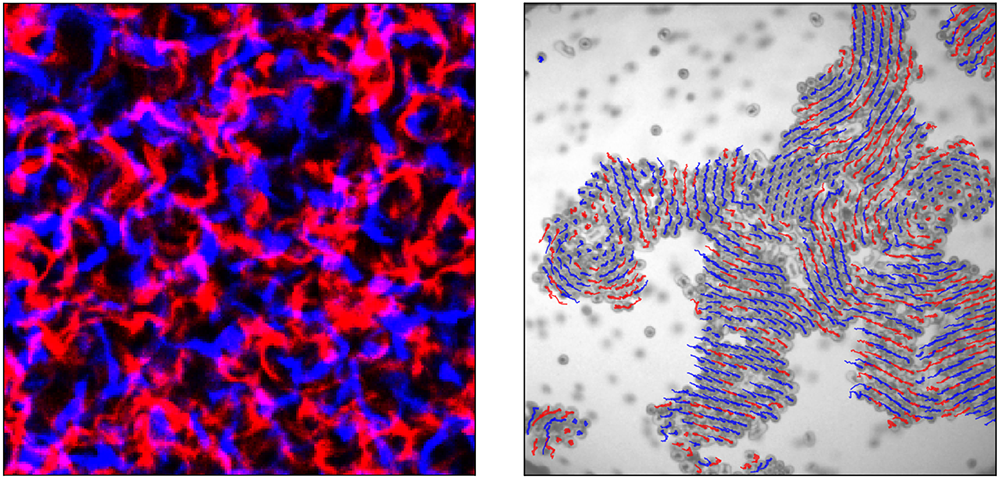
Related consequences of nonreciprocity have recently been observed in mixtures of starfish embryos at different developmental stages [9]. In experiments by Hyunseok Lee of MIT and his collaborators, younger embryos chase older ones, while the older embryos move away (Fig. 1). The researchers attribute this chase-and-escape behavior to nonreciprocal fluid-mediated interactions. In a model calibrated to the experiments, the polarization of the embryos’ motion peaks at intermediate nonreciprocity and decreases at stronger asymmetry as the mixture fragments. Thus, nonreciprocity can both organize and disrupt collective motion, although the detailed mechanism differs from that in the Vicsek models.
Nonreciprocity arises naturally when the constituents of a system follow goals or internal rules rather than simply responding to mechanical forces: Cells send signals to one another, neurons excite or inhibit one another, robot swarms follow programmed instructions, and social groups pursue competing objectives. In such systems, as the three flocking studies demonstrate, nonreciprocal microscopic interactions can qualitatively reshape macroscopic order, opening the door to new forms of collective behavior and unexpected physics.
References
- A. V. Ivlev et al., “Statistical mechanics where Newton’s third law is broken,” Phys. Rev. X 5, 011035 (2015).
- S. Saha et al., “Scalar active mixtures: The nonreciprocal Cahn-Hilliard model,” Phys. Rev. X 10, 041009 (2020).
- M. Fruchart et al., “Non-reciprocal phase transitions,” Nature 592, 363 (2021).
- F. Brauns and M. C. Marchetti, “Nonreciprocal pattern formation of conserved fields,” Phys. Rev. X 14, 021014 (2024).
- Y. Avni et al., “Dynamical phase transitions in the nonreciprocal Ising model,” Phys. Rev. E 111, 034124 (2025).
- C.-U. Woo et al., “Extensive spatiotemporal chaos in nonreciprocal flocking,” Phys. Rev. Lett. 137, 118301 (2026).
- C. Myin et al., “Breakdown of emergent chiral order and defect chaos in nonreciprocal flocks,” Phys. Rev. Lett. 137, 118302 (2026).
- A. K. Dutta et al., “Stability and breakdown of chiral motion in nonreciprocal flocking,” Phys. Rev. E 114, 034115 (2026).
- H. Lee et al., “Topological flowscape reveals state transitions in nonreciprocal living matter,” Phys. Rev. X 16, 031061 (2026).
- T. Vicsek et al., “Novel type of phase transition in a system of self-driven particles,” Phys. Rev. Lett. 75, 1226 (1995).
- J. Toner and Y. Tu, “Long-range order in a two-dimensional dynamical XY model: How birds fly together,” Phys. Rev. Lett. 75, 4326 (1995).
- G. Grinstein et al., “Temporally periodic phases and kinetic roughening,” Phys. Rev. Lett. 70, 3607 (1993).
- M. Kardar et al., “Dynamic scaling of growing interfaces,” Phys. Rev. Lett. 56, 889 (1986).