


Cancer Sets DNA in Motion
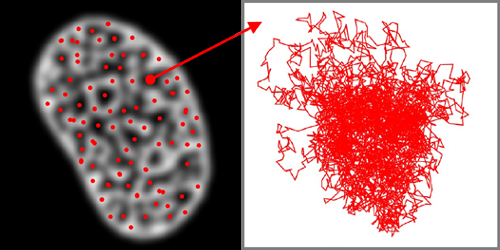

In most cells that are not actively reproducing, DNA resides in a tightly packed state known as chromatin. In this form, the DNA strands are coiled around and cross-linked by various proteins. The viscoelasticity of this cage-like configuration resists the strands’ Brownian motion as well as larger, less frequent movements driven by the cell’s molecular machinery. But in leukemic versions of immune cells, DNA strands become much more mobile. How this mobility is manifest at the microscopic scale and how it potentially influences the course of cancer remain unclear. Now Francisco Monroy of the Complutense University of Madrid and colleagues have used video microscopy to obtain the clearest picture yet of these motions [1]. Their findings suggest that video-microscopic analysis could one day offer an additional way to track disease progression.
Monroy and colleagues studied the motion of local-density concentrations, or granules, in the chromatin of leukemic B and T cells, with healthy T cells as the nonleukemic control. The population of granules exhibited a wide range of mobility. In both healthy and leukemic cells, a granule in the first and fastest mobility quartile could suddenly enter the fourth before relaxing more gradually. This behavior, the researchers say, is consistent with the granule’s locus being driven by active nuclear machinery. But in their Q1-to-Q4 excursions, the leukemic cells covered greater distances.
It was already known that in leukemic B cells, a more permissive chromatin structure loosens the confining cage. But in leukemic T cells, the nuclear environment becomes denser and more viscous, which should suppress motion. Monroy and colleagues hypothesize that in this case the increased motility is due to the nuclear machinery going into metabolic overdrive, a known feature of cancer cells.
–Marric Stephens
Marric Stephens is a Corresponding Editor for Physics Magazine based in Bristol, UK.
References
- M. Calero et al., “Brownian bridging of chromatin states in leukemic cells,” PRX Life 4, 033013 (2026).