


Detecting the Illicit Removal of Nuclear Fuel
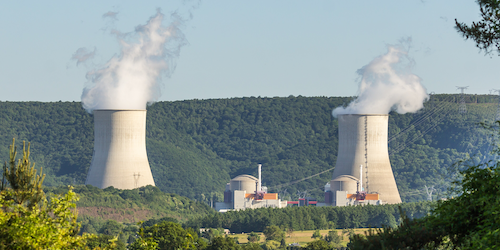

Nuclides used as fuel in nuclear power plants emit antineutrinos, as do their fission products. Over the past two decades, nuclear watchdogs have partnered with researchers to explore whether these antineutrinos could provide independent information on reactor operation and fuel inventories, in service of the watchdogs’ goal of preventing bad actors from removing nuclear fuel for weapons development. These efforts focused on studying antineutrino emission while the nuclear reactors are running. Now the Double Chooz Collaboration has made the first quantitative measurement of the residual antineutrino flux from shutdown-reactor cores and nearby spent-fuel pools at the Chooz nuclear power plant in France. The results suggest that antineutrinos could be used to monitor nuclear material even when the reactors are not running.
The collaboration measured the energy spectrum of emitted antineutrinos over 17.2 days in 2017 while the nuclear reactors were offline. The detected antineutrinos came from beta decays of fission products accumulated in irradiated uranium dioxide fuel remaining in the shutdown-reactor cores and stored in spent-fuel pools. When an antineutrino hit a proton in the detector’s liquid scintillator, a chain of events ensued that ultimately produced light. From the energy and position of the light signals, the researchers inferred the antineutrinos’ energy spectrum. As the antineutrino flux from a shutdown reactor is one hundredth that of an operating reactor, determining the background was crucial, requiring precise modeling, tight control of systematic uncertainties, and state-of-the-art simulations.
In general, the intensity and shape of the antineutrinos’ energy spectrum depend on the quantity of spent fuel, its isotopic composition, and how long it has been cooling. The collaboration’s results indicate that nuclear fuel could be monitored by comparing the spectrum expected from simulations with one measured in situ. But before putting this method into practice, the researchers will need to develop dedicated detectors and validate the method for different reactor and fuel-storage-site configurations.
–Sophia Chen
Sophia Chen is a freelance science writer based in Columbus, Ohio.
References
- T. Abrahão et al. (Double Chooz Collaboration), “First measurement of neutrino emissions from spent nuclear fuel by the Double Chooz experiment,” Phys. Rev. Lett. 137, 061803 (2026).