


A Solid-State Pathway to Neutrino Mass

The discovery that neutrinos oscillate—shifting among three “flavors” (electron, muon, and tau) as they propagate—showed that these elusive particles must have mass. Yet their absolute mass scale and the mass ordering (whether the lightest neutrino state is predominantly electron-, muon-, or tau-like) remain unknown. Determining these properties is a central goal of modern particle physics. A promising approach involves measuring the energy spectrum of electrons emitted in nuclear decay, particularly from tritium: Because the neutrino carries away part of the decay energy, a nonzero neutrino mass slightly modifies the spectrum of emitted electrons. Precision experiments such as KATRIN have pushed this method to its limit, setting an upper bound of about 0.45 eV on the neutrino mass [1]. While KATRIN uses molecular tritium gas, new strategies aim to go further by embedding tritium in engineered materials. For example, the PTOLEMY project at the Gran Sasso National Laboratory in Italy proposes using tritiated graphene (graphene with tritium atoms bound to its surface), which could boost the mass detection sensitivity tenfold [2].
In this context, Valentina Tozzini of the Institute of Nanoscience in Pisa, Italy, and collaborators present a first-principles study of tritium decay on graphene using density-functional theory (DFT) [3]. Their description of how nuclear decay couples to a complex material environment marks an important step toward predicting the electron spectrum in such systems—providing the groundwork for next-generation neutrino-mass experiments based on tritiated graphene.
The premise behind this approach is that functionalized graphene can open a new avenue for probing weak-interaction processes such as radioactive decay. Loosely speaking, tritiated graphene can serve as a neutrino version of night-vision goggles: Just as infrared light striking a photocathode releases electrons that can be detected, tritium acts here as a transducer that converts a radioactive decay involving a neutrino into an emitted electron.
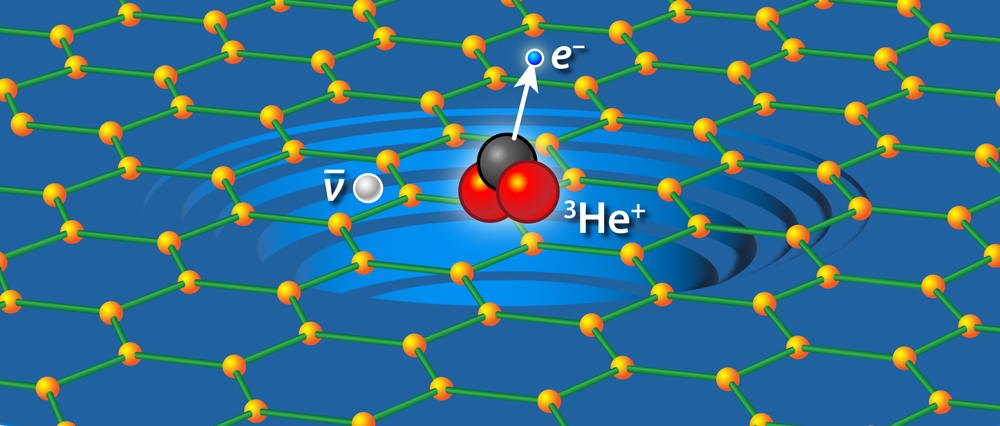
Unlike an infrared detector, however, this transduction proceeds through a change in nuclear states. When tritium bound to a graphene sheet decays, it produces an electron, an (anti-)neutrino, and a recoiling helium-3 ion (Fig. 1). This brings us to the central focus of the paper: which quantum states the helium-3 ion occupies after the decay. Knowledge of such states is essential for relating the measured electron spectrum to the underlying nuclear dynamics in the presence of the substrate—and ultimately to the neutrino mass. As the researchers point out, this intriguing problem involves describing the system’s behavior across a wide range of timescales. To address this challenge, they develop new DFT extensions and combine them with a full analysis of the nuclear configurations involved in the process.
The most energetic electrons emitted in tritium decay are nearly relativistic, traveling close to the speed of light. Their emission imparts an almost instantaneous momentum kick to the helium-3 daughter nucleus, on the ultrafast timescale set by the weak interaction that drives the nuclear transition (on the order of 10-21 seconds). On slower timescales, the surrounding electrons and carbon atoms in graphene respond to this sudden perturbation. Understanding this response is essential for predicting the kinetic energy carried by the emitted electron, which is measured with high resolution far from the decay site.
This separation of timescales makes tritiated graphene an effective “stopwatch” for probing the quantum nuclear dynamics [4]. Helium is inert and interacts only weakly with graphene, so it will eventually detach from the substrate; yet immediately after the decay it remains as a slow-moving ion trapped in the potential well previously occupied by the tritium atom. During this brief interval, the fast, outgoing electron effectively captures a snapshot of the system’s energy configuration. Its energy spectrum extends up to the maximum allowed by the decay—the “end point”— corresponding to the production of (anti-)neutrinos at rest. Under these conditions, the impact of the neutrino mass on spectral distortions is most pronounced and can be probed through high-statistics measurements of the emitted electrons.
The influence of the solid-state environment marks a key difference from conventional experiments using gaseous molecular tritium. In those experiments, sensitivity to the neutrino mass is confined to the narrow region near the end point, requiring very intense tritium sources to accumulate sufficient statistics. Moreover, this region is effectively broadened by the many possible rovibrational excitations of the daughter molecular ion (³HeT+) produced by the decay of diatomic tritium (T2). As a result, the end point consists of a dense manifold of closely spaced spectral features that cannot be experimentally resolved.
Conversely, when tritium is bound to graphene, the much heavier substrate suppresses the recoil of the helium-3 nucleus so that essentially no kinetic energy is subtracted from the emitted electron. This behavior is reminiscent of the effect underpinning Mössbauer gamma-ray spectroscopy: Recoil-free emission from nuclei bound to a solid leads to extremely sharp spectral features. If helium remains confined in a three-dimensional potential, it occupies a discrete set of bound states. Each of these states corresponds to a different excitation energy and therefore to a slightly different end point in the electron energy spectrum. As a result, the neutrino-mass-induced distortion is not confined to a single end point but reproduced at each of these energy thresholds. The resulting pattern—encoded in the number, positions, and amplitudes of the spectral features—provides a detailed fingerprint of the postdecay dynamics and offers multiple handles for extracting information about the neutrino mass.
The researchers explore different approximations tailored to the extreme, nonadiabatic conditions of the decay. In the sudden approximation, the electronic structure is assumed to remain frozen immediately after the transition, while in the semisudden approximation it follows the nuclear position without fully relaxing. Both approaches predict a discrete set of excited bound states for helium. They also predict that above each excitation threshold the density of states becomes relatively sparse over energy intervals of order 20–200 meV. This is precisely the region where the effects of a finite neutrino mass are expected to manifest. Importantly, these energy spacings lie within the projected energy resolution of PTOLEMY ( 10 meV).
These results highlight both the promise and the challenges of modeling decay in complex environments, where multiple timescales and many-body effects must be treated consistently. Yet they also point to a qualitatively new regime, in which solid-state systems can enhance rather than obscure the underlying physics.
I can only encourage the researchers—onward and upward!—as their work moves toward an exciting confrontation with experiment. More broadly, the convergence of neutrino, nuclear, solid-state, and atomic physics is ushering in a new era of ultrasensitive experimentation that could lead to profound discoveries about the fundamental laws of nature.
References
- M. Aker et al. (KATRIN Collaboration), “Direct neutrino-mass measurement based on 259 days of KATRIN data,” Science 388, 180 (2025).
- M.G. Betti et al., “Neutrino physics with the PTOLEMY project: Active neutrino properties and the light sterile case,” J. Cosmol. Astropart. Phys. 2019, 047 (2019).
- A. Casale et al., “-decay spectrum of tritiated graphene: Combining nuclear quantum mechanics with density functional theory,” Phys. Rev. C 113, 054607 (2026).
- A. Apponi et al. (PTOLEMY Collaboration), “Heisenberg’s uncertainty principle in the PTOLEMY project: A theory update,” Phys. Rev. D 106, 053002 (2022).