


The Shell Model’s Shell Game

The shell model describes how protons and neutrons (nucleons) fill up their respective energy levels, or orbitals, as they increase in number. Once a nucleus contains six or more protons, a gap opens between the sixth and the seventh proton energy levels. Indirect measurements led to the claim that this “Z = 6 gap” persists with increasing neutron number and makes Z = 6 a magic number, or “shell closure,” analogous to the stable electron configurations of the noble gases. Now Beatriz Fernández Domínguez and Juan Lois-Fuentes of the University of Santiago de Compostela in Spain and their colleagues have directly measured the gap in oxygen-20 and have found that the gap is not persistent but narrows with increasing neutron number [1]. What’s more, they found that the narrowing is mainly attributable to the tensor interaction—a component of the nuclear force between nucleons that depends on the relative orientation of their spins and positions.
The gap in question is a so-called spin–orbit splitting between proton states in which the proton’s spin is either aligned or antialigned with its orbital motion. The lack of a complete microscopic understanding of spin–orbit splitting—a common phenomenon in nuclei—lies at the heart of the disagreement.
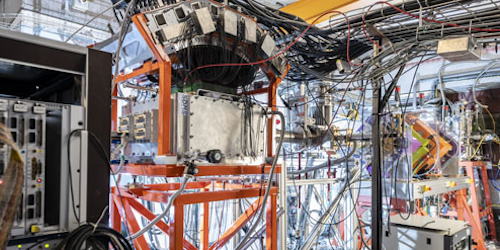
At the Active Target and Time Projection Chamber (ACTAR TPC) facility at GANIL in France, the researchers aimed an oxygen-20 beam at a gas target of molecular deuterium and isolated the collisions that removed a proton to create nitrogen-19. From the energies and populations of eight proton orbitals, the team inferred that the Z = 6 shell gap in oxygen-20 is 5.3 MeV, about 1.8 MeV smaller than in oxygen-16, which has four fewer neutrons. The finding suggests that Z = 6 does not correspond to a true shell closure in neutron-rich oxygen isotopes. Applying a standard theoretical model to the data revealed that 95% of the gap narrowing arises from the tensor force between protons and neutrons in two orbitals that are close in energy.
–David Ehrenstein
David Ehrenstein is a Senior Editor for Physics Magazine.
References
- “Quenching of the 0p3/2 – 0p1/2 spin-orbit splitting in 20O and the effect of the tensor force,” Phys. Rev. Lett. 136, 212501 (2026).