


Cutting the Tail of a Photon
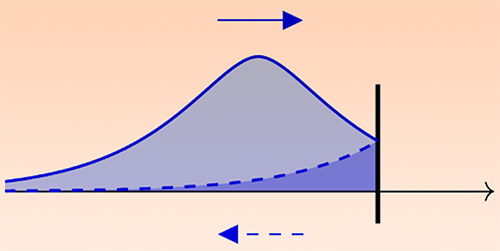

There is no such thing as half a photon. As a fundamental particle, a photon is indivisible, but it can also be described in terms of its wave packet, implying a spatial distribution that could be cut into pieces. Isak Rukan at the University of Oslo in Norway and his colleagues have now rigorously analyzed such a scenario [1]. Specifically, they calculated what would happen if a mirror were to vanish suddenly while a single photon’s wave packet was reflecting from it.
The researchers imagined a photon with a single peak propagating from left to right toward a mirror. When only the photon’s leading slope has encountered the mirror and is now propagating leftward, the mirror is removed. Intuitively, one might suppose that the photon simply splits in two, with the unreflected portion of the waveform continuing rightward. Or, thinking quantumly, maybe the mirror’s removal creates a superposition of left- and right-propagating photons.
Rukan and colleagues predicted a stranger outcome that arises from a rule within quantum field theory: The waveform of a single photon cannot have a sharp edge such as would form if the mirror vanished abruptly. But a superposition of multiple photons can have such an edge—and the sharper the edge gets, the more photons are superposed.
The researchers modeled this phenomenon using so-called Bogoliubov transformations, which result from the time-dependent change in the quantum-field modes caused by removing the mirror. This removal exerts a tug on the quantum field, which pulls just enough photons out of the vacuum to form a suitably sharp edge. For an instantaneous removal, the expected photon number rises to infinity. But for slower, experimentally feasible scenarios, the number is small, Rukan says.
–Marric Stephens
Marric Stephens is a Corresponding Editor for Physics Magazine based in Bristol, UK.
References
- I. C. Onsager Rukan et al., “Truncated photon,” Phys. Rev. Lett. 137, 033601 (2026).