


Quantum States Cannot Hide Their Origin
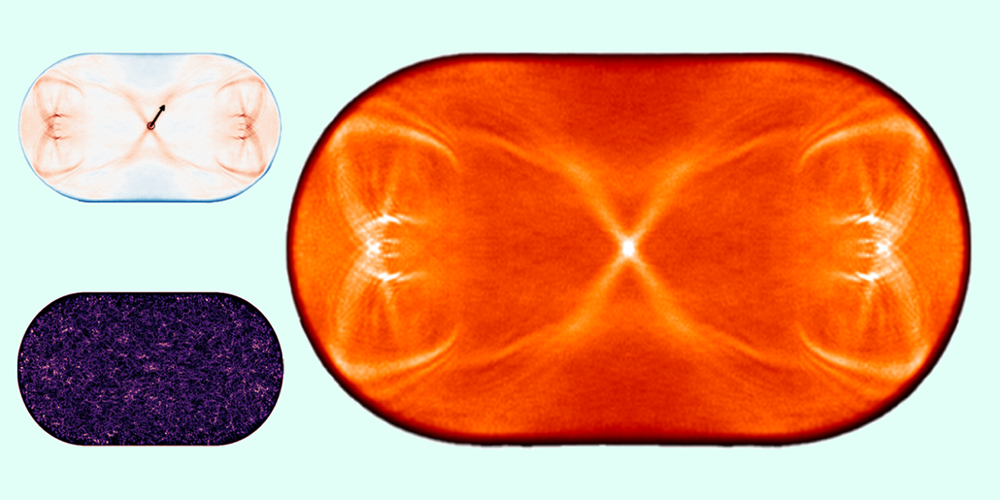

Ergodic behavior—in which a system explores all its possible physical states over time—is the foundation of statistical mechanics. A hallmark of classical ergodicity is the complete loss of memory of initial conditions. For instance, a ball bouncing around on a chaotic billiard table eventually visits every part of the table with equal probability. Hence, after a long time, it is no longer possible to deduce its starting point—the memory of its origin has been erased. But what happens to memory in the quantum version of this system? If one launches an initially localized wave packet on a quantum billiard “table,” it quickly scrambles and evolves into a randomly looking time-dependent state. However, Anton Graf from Harvard University and colleagues now show that the time-averaged probability of finding the quantum system back in its initial state is increased by at least a factor of 2 compared to any other unrelated state—and this enhancement persists even in the infinite-time limit [1]. This imprint, which the researchers call a quantum birthmark, could lead to better understanding of the elusive quantum nature of ergodicity and of the bridge between classical and quantum chaos.
To explore memory in a quantum system, Graf and colleagues propose using the time-averaged occupation probability Pba, which is the likelihood of an initial state a evolving to another state b over some late time t. This diagnostic differs from other statistical measures in that it focuses on the time-averaged evolution of the states rather than their energetic transitions. In the purely ergodic case, the probability of winding up in state b is Pba = 1/N, where N is the total number of available states in the system. However, the researchers show that, remarkably, the probability of returning to the initial state (b = a) is quantum mechanically enhanced: Paa/Pba ≥ 2.
This nonergodic behavior is purely due to quantum interference. It can roughly be understood by considering a particular state as a wave packet composed of steady (single-energy) waves, called eigenstates. The contribution of each eigenstate is defined by a corresponding probability distribution, called its weight. Computing Pba involves multiplying the weights of a with the corresponding weights of b, and then summing the products over all eigenstates. When b is a time-evolved state of a, their weights are correlated with each other, and the corresponding probability is enhanced relative to two different states with uncorrelated weights.
Graf and colleagues go on to show that the enhancement factor is the same for all time-evolved intermediate states beyond some equilibration time ti, that is, Paa(ti < t) = Paa(t). They also find that this universal factor can be higher than 2 in special cases, such as when the initial wave packet is launched along a short classical periodic path and partially returns to itself at early times. This partial periodicity is where the work connects to quantum scarring, a well-known phenomenon discovered by one of the researchers, Erik Heller from Harvard [2]. In its essence, scarring refers to an enhanced probability density of eigenstates along short, unstable classical periodic orbits in quantum systems with a well-defined classical limit. The stronger-than-2 enhancement reflects the fact that scarring protects a quantum system from the scrambling of information caused by equilibration. To extend the birthmark analogy, a quantum system at late times is not only shaped by its birth but also carries “scars” from its early childhood.
Graf and colleagues demonstrate the quantum-birthmark phenomenon in the stadium billiard—a textbook example of a 2D chaotic system with a racetrack-shaped boundary [3]. In computer simulations, the team seeded this billiard system with a variety of initial wave packets, launching them either along generic chaotic trajectories or along well-known classical periodic orbits. The computed enhancement factor was about 2 for generic cases, but it went up to about 8 for those cases corresponding to initially periodic orbits. While at any single instant the time-evolved wave packets look completely scrambled, as chaos would imply, the quantum memory only shows up in the long-time average (Fig. 1).
At face value, quantum birthmarks seem to contradict the eigenstate thermalization hypothesis [4], a standard framework that says that the expectation value of a quantum observable converges to its classical average for almost all eigenstates. The birthmark, however, is not a property of the state itself but rather a property of the spectral decomposition of the initial state. As such, the birthmark framework offers a new perspective on thermalization, leading to several important realizations: First, it implies that quantum thermalization is never quite complete, that is, at least in principle, the initial condition remains statistically detectable forever as long as the system does not decohere. Second, it extends various mechanisms that are known to cause weak ergodicity breaking—such as scarring in single-particle [2, 5] and many-particle [6–8] systems or boundary effects. Indeed, the quantum-birthmark mechanism offers a way to unify some ergodicity-breaking phenomena.
Seeing quantum birthmarks in this larger framework raises interesting questions, particularly with regard to many-particle systems and statistical mechanics. For instance, as a rule of thumb, Heller-type scars are associated with periodic orbits having small Lyapunov exponents—parameters characterizing the level of chaos in a system. For many-body systems, this condition generalizes to an upper bound on the sum of Lyapunov exponents. This requirement is difficult to fulfill, making Heller-type scarring rare in many-body systems, except for a few notable examples [7, 8]. Thus, it remains to be explored how much the quantum-birthmark effect might be enhanced by scarring in many-body systems.
Looking further, the work of Graf and colleagues may offer a new perspective on the emergence of classical chaos from quantum chaos. The formalism that the researchers use highlights a shift from stationary to nonstationary states (that is, from the energy domain to the time domain) in questions regarding quantum thermalization. This focus on time evolution aligns the quantum treatment more with that of classical mechanics. As such, researchers may find new ways to connect quantum dynamics to classical thermalization and related concepts such as the emergence of an “arrow of time.”
On the subject of quantum and classical overlap, there is an intriguing similarity between the quantum-birthmark phenomenon and coherent backscattering (CBS). The latter is an interference effect that was originally observed in light waves propagating along direct and reverse paths in disordered media [9]. But CBS has also been observed in ensembles of interacting cold atoms confined to a 1D artificial lattice. The atoms behave as a chaotic many-body system, and yet—through CBS quantum interference—the average return probability to the initial many-body state is permanently enhanced by a factor of 2 [10]. A potentially fruitful direction for future work might be to explore the connection between CBS and quantum birthmarks.
Finally, experimental verification would, of course, be welcome. It remains to be seen which platform might offer the best opportunity for uncovering birthmark signatures. One prediction is for sure, though: As long as quantum coherence is maintained, a quantum birthmark should last forever. But if it fades, that would signify decoherence and a step toward classical ergodicity.
References
- A. M. Graf et al., “Quantum birthmarks: Ergodicity breaking beyond scarring,” Phys. Rev. X 16, 031063 (2026).
- E. J. Heller, “Bound-state eigenfunctions of classically chaotic Hamiltonian systems: Scars of periodic orbits,” Phys. Rev. Lett. 53, 1515 (1984).
- L. Bunimovich, “Dynamical billiards,” Scholarpedia 2, 1813 (2007).
- M. Srednicki, “Chaos and quantum thermalization,” Phys. Rev. E 50, 888 (1994).
- E. B. Bogomolny, “Smoothed wave functions of chaotic quantum systems,” Phys. D 31, 169 (1988).
- C. J. Turner et al., “Weak ergodicity breaking from quantum many-body scars,” Nat. Phys. 14, 745 (2018).
- Q. Hummel et al., “Genuine many-body quantum scars along unstable modes in Bose-Hubbard systems,” Phys. Rev. Lett. 130, 250402 (2023).
- A. Pizzi et al., “Genuine quantum scars in many-body spin systems,” Nat. Commun. 16, 6722 (2025).
- E. Akkermans et al., “Coherent backscattering of light by disordered media: Analysis of the peak line shape,” Phys. Rev. Lett. 56, 1471 (1986).
- Th. Engl et al., “Coherent backscattering in Fock space: A signature of quantum many-body interference in interacting bosonic systems,” Phys. Rev. Lett. 112, 140403 (2014).