


Tuning Light Polarization with Quantum Geometry
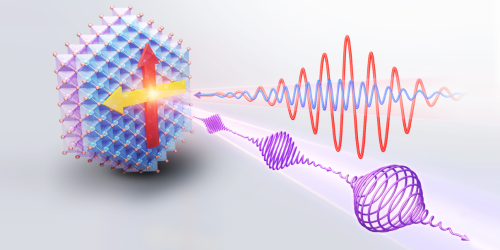

Researchers have developed a method for controlling the polarization of light scattering from a crystal [1]. Such polarization tuning is not new, but the method here relies on quantum geometry—a material’s “internal terrain” that affects electron behavior. The scheme could open up new capabilities in spectroscopy and photonic information storage.
For their method, Ya Bai from the Chinese Academy of Sciences and colleagues start with a crystalline material having specific symmetry properties. These properties impart a so-called geometric phase, which is a shift in the wave functions of the electrons moving through the crystal. It’s this quantum geometry that the researchers use to manipulate the polarization of light reflecting off the crystal.
In experiments, the team shined a strong laser pulse on their crystal. The laser light was linearly polarized and composed of two light fields, the frequency of one being twice that of the other. The light reemitted by the crystal included several higher-frequency components, referred to as harmonics. The team showed that they could control the polarization of these harmonics. Specifically, they could obtain any desired polarization (linear, circular, or elliptical) and handedness (left or right) just by tuning the relative strengths and phases of the two input light fields.
This quantum-geometry method, which differs from traditional polarization-control methods based on birefringent materials, offers some unique advantages, Bai says. For one, the new method can work in the extreme ultraviolet, where it could benefit the spectroscopic study of chiral molecules. It is also optically driven, which means the polarization can be altered on femtosecond timescales—a possible boon to efforts to store information in a light beam’s polarization.
–Michael Schirber
Michael Schirber is a Corresponding Editor for Physics Magazine based in Lyon, France.
References
- Y. Bai et al., “Chiral high-harmonic generation via subcycle symmetry engineering,” Phys. Rev. Lett. 137, 116905 (2026).