


Nanoparticle Motion Measured Beyond Quantum Limit
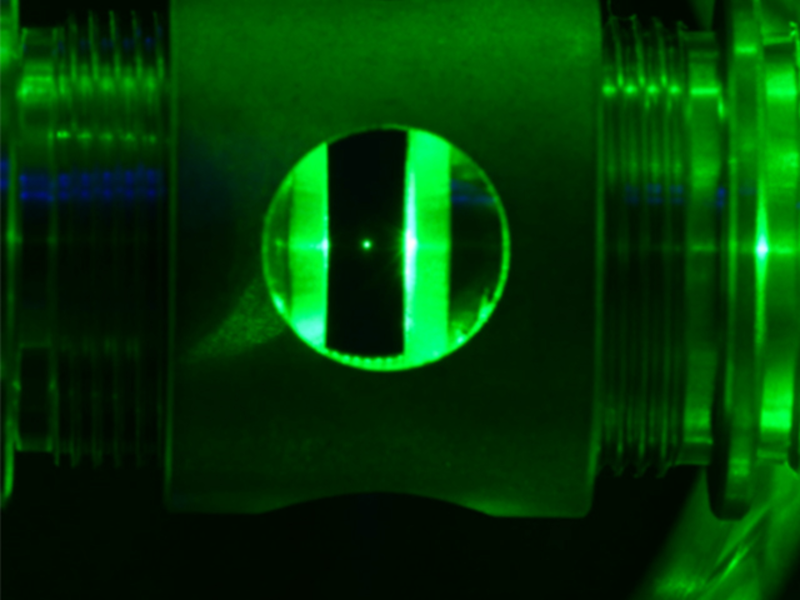

Researchers have a bold plan to detect unknown fundamental particles: Levitate a nanoscale object in a vacuum and watch for a microscopic recoil caused by a collision with an exotic particle. Precision measurements of macroscopic objects have been a challenge, but now a research team has demonstrated a significant sensitivity improvement with a levitated object some 6 orders of magnitude larger than in previous experiments [1]. The team hopes the method will find use in experimental searches in the next few years.
Searching for particles not accounted for by the standard model of particle physics requires experiments with unprecedented sensitivity. One method is to use laser light to levitate a small object in a vacuum, isolating it from surrounding noise. Researchers can monitor its motion and potentially detect minuscule recoils caused by rare collisions with exotic particles, such as those of dark matter.
The larger the test object, the more likely it is to interact with something, says graduate student Martynas Skrabulis of ETH Zurich. However, so-called quantum zero-point noise adds fluctuations that can overwhelm such measurements, and this noise increases with the object’s size. So it has not been possible to measure a macroscopic test object with the required precision.
Researchers have previously used an amplification trick to measure the motion of a single ion or even a crystal consisting of 150 ions [2, 3]. The trick involves quantum squeezing, where the quantum noise in one variable, such as momentum, can be reduced at the expense of increasing it in another variable, such as position. Manipulating quantum squeezing can amplify the effect of a sudden, small kick to the object, making it easier to detect.
Skrabulis is part of Lukas Novotny’s team at ETH, which has been developing nanoparticle levitation for many years. Among other technical advances, these researchers have been able to cool a nanoparticle down to its lowest energy quantum state, thereby reducing the momentum uncertainty to the lowest possible level. They have now demonstrated a version of the amplification trick using a levitated nanoparticle and have detected a signal that would normally be lost in the zero-point quantum noise.

The team trapped a 100-nm-diameter silica nanoparticle in a laser beam at low temperature (5.6 K) under ultrahigh vacuum. The trapped nanoparticle acts like a marble rolling back and forth in a smooth basin or valley. Following a typical squeezing protocol, the researchers briefly reduced the steepness of the trapping potential, equivalent to widening the valley. With a wider trap, the nanoparticle’s position variance expands, and according to the uncertainty principle, its momentum uncertainty is reduced.
The nanoparticle carries a small electric charge, which allowed the researchers to mimic the effects of a small impact by applying a 1-microsecond voltage pulse to a pair of electrodes surrounding the laser trap. The short kick slightly boosts the nanoparticle’s momentum. Next, they allowed the system to evolve for another quarter period before rapidly restoring the trap’s original shape. This antisqueezing step reverses the initial redistribution of uncertainty and in the process amplifies the momentum change to a level above the noise.
The researchers found that without the amplification procedure, averaging of 200 measurements of this kind was required to resolve the kick amid the quantum noise. But with the procedure, only one measurement was needed, and it allowed them to resolve a force that was only 90% of the standard quantum noise limit.
“This is a very exciting piece of physics,” says Thiago Guerreiro of the Pontifical Catholic University of Rio de Janeiro. “It has been made possible by exquisite advances in quantum control of the levitated particle and now opens up a myriad of possibilities for fundamental physics in tabletop experiments and applications in metrology.”
In addition to detecting hypothetical particles of dark matter, the technique may also prove useful in detecting neutrinos or unusual particles emitted in nuclear decays, Skrabulis says. In principle, he adds, the enhanced accuracy possible with such measurements is limited only by the amount of squeezing that can be generated.
–Mark Buchanan
Mark Buchanan is a freelance science writer who splits his time between Abergavenny, UK, and Notre Dame de Courson, France.
References
- M. Skrabulis et al., “Nanomechanical sensor resolving impulsive forces below its zero-point fluctuations,” Phys. Rev. Lett. 136, 233604 (2026).
- S. C. Burd et al., “Quantum amplification of mechanical oscillator motion,” Science 364, 1163 (2019).
- K. A. Gilmore et al., “Quantum-enhanced sensing of displacements and electric fields with two-dimensional trapped-ion crystals,” Science 373, 673 (2021).