


Illuminating Iron Clusters’ Magnetism
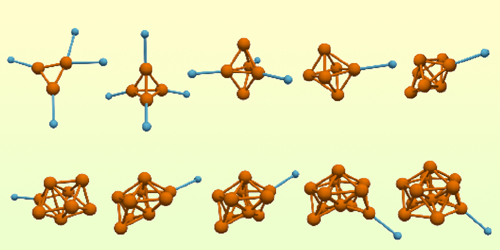

Nanoscale atomic clusters exhibit electronic properties unlike those of bulk materials made of the same atoms. Those properties depend sensitively on how the atoms are arranged, and they become hard to predict as the number of atoms rises beyond a handful. This is especially the case for transition metals, since magnetic interactions between atoms both affect and are affected by the cluster’s geometry, producing a feedback loop that is difficult to disentangle. Now Kevin Anthony Kaw and colleagues at KU Leuven in Belgium and HFML-FELIX in the Netherlands have demonstrated a spectroscopy-based method for characterizing the geometry and spin configuration of clusters comprising 3–12 iron atoms [1]. Their technique could improve understanding of iron clusters in natural settings such as interstellar space and in industrial processes such as ammonia synthesis, where the clusters serve as catalysts.
The researchers measured clusters’ vibrational spectra at infrared wavelengths using a continuously variable free-electron laser. As a single cluster is too small to return a measurable spectral signature, they studied beams of clusters tagged with argon atoms. At 150 K these argon atoms were loosely bound to the clusters, but a cluster would shake off its argon when its interatomic bonds had been excited to a higher vibrational state by the laser. By sweeping the laser’s wavelength while looking out for argon-deficient clusters, the researchers defined the characteristic frequencies that would excite clusters of each size. They then identified the geometry and spin configurations for those clusters by finding the best matches among a catalog of spectral fingerprints predicted by theoretical supercomputer calculations. In future work, Kaw and colleagues plan to use the technique to measure the spin magnetic moments of larger iron clusters, other types of transition metals, and metal-oxide clusters.
–Sophia Chen
Sophia Chen is a freelance science writer based in Columbus, Ohio.
References
- K. A. Kaw et al., “Resolving spin state discrepancies of small cationic iron clusters by far-infrared vibrational spectroscopy,” Phys. Rev. Lett. 137, 013002 (2026).