


Molecular Imaging Without the Wait
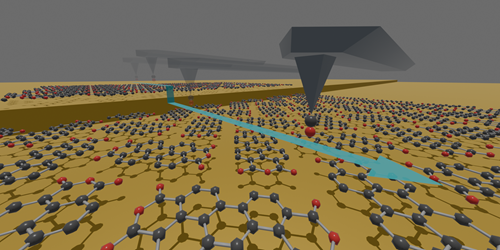

Atomic force microscopy has revolutionized molecular imaging by uncovering the chemical structures of single molecules. But its broad use has been hampered by low imaging speeds and a need to operate the microscope at a fixed height above the sample. Now Yuuki Yasui and Yoshiaki Sugimoto at the University of Tokyo have built an atomic force microscope that lacks those limitations [1]. Scientists could use this instrument to watch chemical reactions unfold on surfaces in real time and to probe the structures of complex, 3D molecules.
In atomic force microscopy, a sharp tip is mounted on a flexible cantilever and scanned over a material surface. The forces between the tip and the sample deflect the cantilever or alter the frequency of its vibrations. These changes are then converted into a map of the surface with atomic-scale resolution. When imaging molecules on the surface, the tip must typically move slowly and at a constant height to detect extremely small variations in force.
Yasui and Sugimoto boosted the sensitivity of their microscope to these force variations by operating the instrument’s cantilever at its second natural vibration frequency rather than the fundamental frequency that is normally used. This advance allowed the researchers to sweep the microscope’s tip across individual molecules at speeds of up to 200 nanometers per second, more than 60 times faster than was previously possible. Doing so cut down the time required to make an image from about 30 minutes to about 30 seconds. The increased sensitivity also removed the constant-height restriction, enabling the microscope to image nonplanar surfaces and molecules.
–Ryan Wilkinson
Ryan Wilkinson is a Corresponding Editor for Physics Magazine based in Durham, UK.
References
- Y. Yasui and Y. Sugimoto, “Breaking the speed limit of chemical-structure imaging with enhanced force sensitivity,” Phys. Rev. Lett. 137, 046202 (2026).