


Gravitational Constant’s Value Still Up in the Air


Gravity is our most familiar force. Standing on Earth, we feel its pull, and gazing up at the sky, we see its effect on planets and comets. And yet the gravitational constant—affectionately called big G—is one of the hardest fundamental constants to measure precisely. In a replication of an earlier experiment, a group from the National Institute of Standards and Technology (NIST) in Maryland has released a new G value [1]. The results show a disparity between measurements, highlighting how small background effects continue to weigh down precision metrology efforts.
Big G is the constant in Newton’s law of gravitation, which describes the force of attraction between two massive bodies. Henry Cavendish first measured it in the laboratory in 1798. His experiment involved a torsion balance: two test masses attached to opposite sides of a thin rod that is suspended from the ceiling by a narrow fiber. The test masses are brought next to two fixed masses, causing a gravitationally induced rotation. Cavendish’s measurements inferred a value of G of 6.74 × 10⁻¹¹ m3/kg/s2.
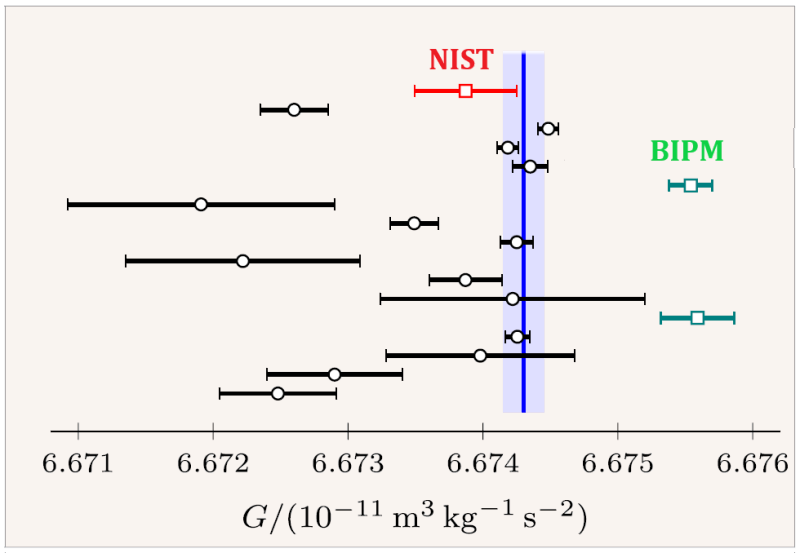
Many subsequent measurements of the gravitational constant have been carried out, often employing variants of Cavendish’s torsion balance. Over the past 40 years, about a dozen high-precision experiments have reported values of G that don’t line up well with each other. “When you look at the data, there is a lot of scatter in the estimates,” says Stephan Schlamminger from NIST. The values differ by several hundred parts per million (ppm), which is relatively large compared to other fundamental constants, such as the electrostatic (Coulomb) force constant, whose uncertainties are at the parts-per-billion level.
One reason for this tension is the relative weakness of gravity, Schlamminger says, which makes it difficult to isolate from outside forces and environmental effects. Schlamminger speaks from experience: He and his colleagues have spent the past decade working to control these backgrounds. “There’s a lot of moving pieces—a bit too many pieces, now looking back.” The NIST team’s setup replicates another experiment performed at the International Bureau of Weights and Measures (BIPM) in France. The result from this earlier experiment, which was reported in 2014, gave one the largest recent values of G, 200 ppm above the world average [2]. Redoing this experiment was therefore a natural place to look for the source of the tension, Schlamminger says.
The NIST–BIPM setup has several distinctive features. Most notably, it uses four test masses rather than the two of the original Cavendish experiment. Schlamminger explains that the two extra masses decrease the sensitivity to background gravitational disturbances, such as those caused by a person walking through the laboratory. But the four-mass setup comes with a drawback: The position of the masses must be measured with extreme precision.
Another feature is the use of two independent force measurements. One is the traditional method of detecting the rotation of the balance and inferring the restoring torque from the supporting fiber. The other determines the gravitational force by measuring an electrostatic force that exactly balances it.
The NIST researchers performed observations over several years, during which they blinded their data to avoid bias toward any particular value. After unblinding, the team’s G estimate came out to be 6.67387 × 10⁻¹¹ m3/kg/s2, with an uncertainty of 57 ppm. The result agrees with the world average within 1 standard deviation, but it is 250 ppm lower than the BIPM value.
These results imply that background effects are still playing a role. Schlamminger and his colleagues investigated several possible causes, including temperature imbalances and density variations in the masses, but none appeared significant enough on its own. “We were not able to identify a single ‘smoking gun,’ so it’s probably a multitude of causes,” he says.
Schlamminger plans to take a break from G measurements. But he remains enthusiastic about future experiments using alternative methods such as atom interferometry. Like other constants, the G value is steadily getting more precise with time. “It provides a yardstick for measurement technology that future civilizations can compare to,” he says.
–Michael Schirber
Michael Schirber is a Corresponding Editor for Physics Magazine based in Lyon, France.
References
- S. Schlamminger et al., “Redetermination of the gravitational constant with the BIPM torsion balance at NIST,” Metrologia 63, 025012 (2026).
- P. J. Mohr et al., “CODATA recommended values of the fundamental physical constants: 2022,” Rev. Mod. Phys. 97, 025002 (2025).