


Predicted Noncrystalline Structures Have Bonus Properties
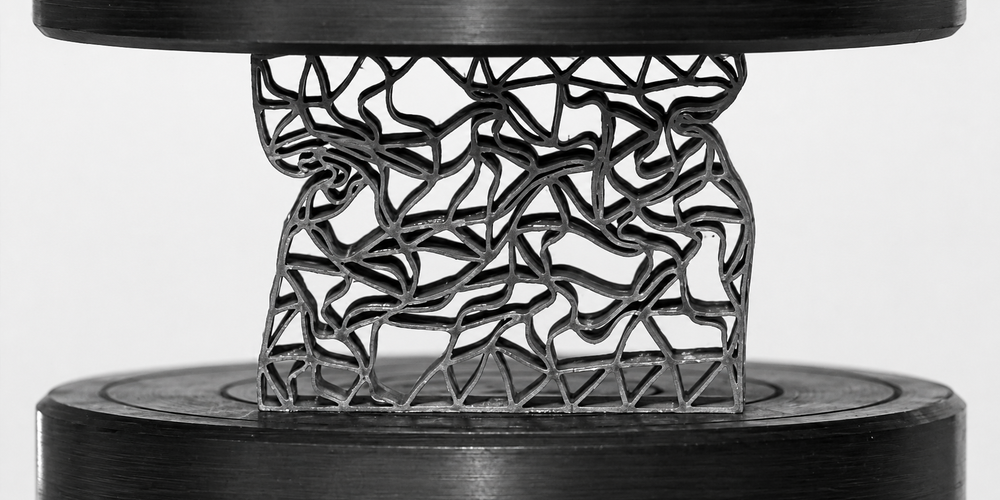

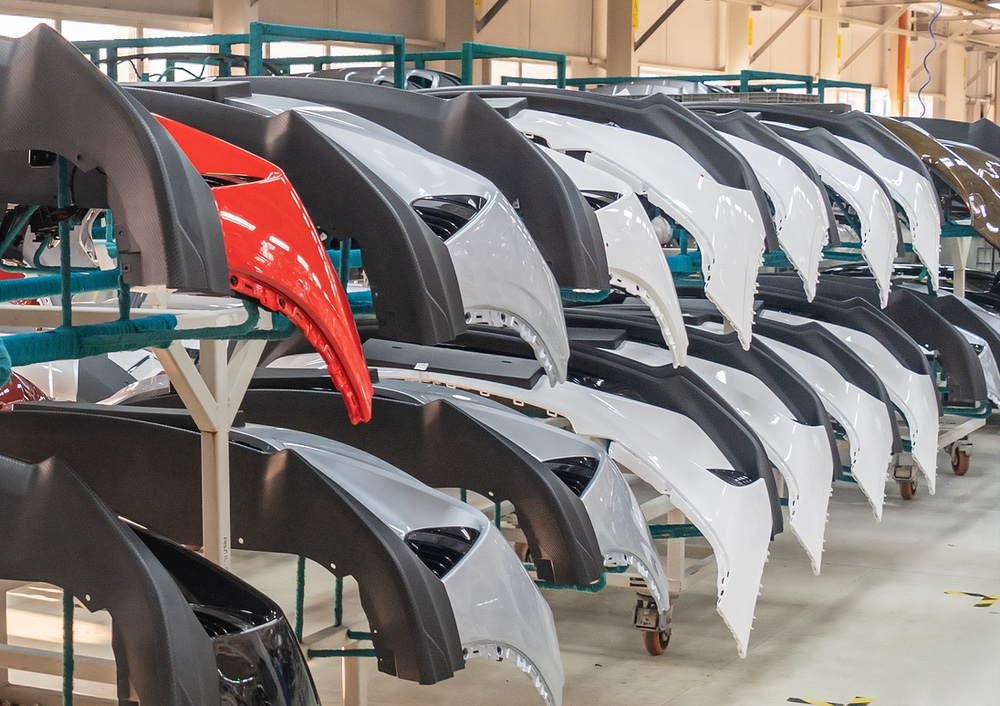
Metamaterials derive their unique properties from their tailored, macroscale structures, not from their chemical compositions or atomic-scale structures. Although designers often rely on regular, repeating architectures, many of nature’s toughest materials—from bone to spider silk—owe their resilience to structural disorder. Now, inspired by those biological examples, researchers have used machine learning to find new designs for disordered metamaterials [1]. These structures not only have the properties for which they were optimized, but they also resist deformation and fracture. The researchers have built a prototype car bumper based on their designs, and they propose uses in ballistic shields, helmets, and other protective equipment.
The design of functional metamaterials has conventionally focused on ordered structures, where the repeating nature of the patterns allows predictions of macroscopic behavior. Amorphous structures lack that periodicity, leaving an enormous number of possible disordered arrangements that are difficult to explore systematically. Yet disorder can also be an asset, enabling mechanical behaviors that are otherwise difficult or impossible to achieve. The main challenge has been to search the large number of potential structures efficiently enough to identify the rare ones that combine useful functionality with physical stability.
To overcome this hurdle, Lei Xu of the Chinese University of Hong Kong and his colleagues reframed the metamaterials-design problem in terms of statistical physics. They defined an “energy landscape” in which each point on a surface represents a mechanically stable disordered structure. Each point is assigned an energy, represented as an altitude—the closer a structure is to having the desired properties, the lower its altitude. So valleys represent the best structures.
For their demonstration, the researchers focused on two attributes desirable for protective equipment. The first attribute was auxeticity, the degree to which applying a stretching force to a material in one direction causes it to expand in the perpendicular direction. The second was mechanical isotropy, the degree to which a material’s response to a force is independent of the force’s direction. To simplify the problem, the team investigated 2D designs that can be readily extruded into the third dimension to produce practical 3D metamaterial structures.
Xu and his colleagues used a machine-learning technique called Boltzmann annealing to efficiently explore the energy landscape and search for its deepest valleys. Xu and his colleagues then chose a few of the best structures and 3D printed millimeter-scale prototypes. These prototypes were composed of a light, flexible polymer known as thermoplastic polyurethane.
The team performed a series of compression and impact tests on the metamaterials to investigate their mechanical responses. As expected, the structures had both high auxeticity and high mechanical isotropy. But surprisingly, they also had useful properties that were not explicitly targeted by the optimization. These included impressive impact resistance, energy absorption, and fracture resilience.
The researchers’ experiments suggest a physical mechanism for this unexpected performance. Whereas periodic metamaterials concentrate stress into specific weak regions that allow cracks to spread rapidly, the disordered structures seem to diffuse stress uniformly, making crack propagation more difficult.
“Our approach provides a general tool that can be adapted to design amorphous materials optimized for thermal, acoustic, or optical functions,” Xu says. “Structural disorder is not a defect but a robust and programmable design principle.”
“I think what makes this work important is not just the design methodology,” says materials scientist Nidhi Pashine of Syracuse University in New York. “Their results are essentially at a point where these designs can be deployed in real materials and are ready for actual applications.”
–Ryan Wilkinson
Ryan Wilkinson is a Corresponding Editor for Physics Magazine based in Durham, UK.
References
- L. Jia et al., “Unlocking emergent resilience in amorphous metamaterials via a physics-constrained energy-based framework,” Phys. Rev. X 16, 031024 (2026).