


Twisted Bilayers Are Hard to Pin Down
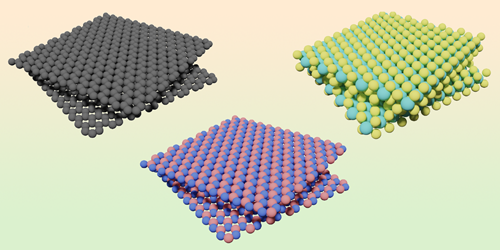

If two egg cartons are stacked so that their respective peaks and troughs lock together, then one cannot be slid over the other. But stack them with a twist so that they no longer align, and the top carton can slide along the peaks of the bottom carton. Something similar occurs between the sheets of bilayer graphene and other 2D materials. In a regular bilayer with aligned lattices, the sheets are pinned in an energetically favorable configuration. But for certain twist angles, the two-layer superlattice lacks long-range order, no configuration is favored, and one sheet can move freely over the other. Jin Wang and Erio Tosatti at the International School for Advanced Studies (SISSA) in Italy have now found that this friction-free state is remarkably resilient [1].
The transition from sliding to pinning was first analyzed 40 years ago for a chain of particles moving through a periodic 1D potential [2]. When the particle spacing matches the periodicity of the potential, the chain is pinned and immobile. When it does not—a so-called incommensurate state―the chain slides freely. But even in this state, pinning can occur unexpectedly when the chain’s flexibility or the potential’s depth exceeds certain values. Wang and Tosatti tackled the problem in 2D materials by simulating bilayers of graphene, hexagonal boron nitride, and molybdenum disulfide. They varied the twist angle, the stiffness of the sheets, and—as an analogue for the potential depth—the mechanical load placed on the sheets. They found that the free-sliding state persisted for twist angles as small as 0.3° and for loads as large as 10 gigapascals. Thanks to the state’s robustness, twisted bilayers could be used to engineer low-friction surfaces in nanoelectromechanical devices, the researchers say.
–Marric Stephens
Marric Stephens is a Corresponding Editor for Physics Magazine based in Bristol, UK.
References
- J. Wang and E. Tosatti, “Aubry pinning transition of twisted two-dimensional material bilayers,” Phys. Rev. B 112, 155406 (2025).
- M. Peyrard and S. Aubry, “Critical behaviour at the transition by breaking of analyticity in the discrete Frenkel-Kontorova model,” J. Phys. C: Solid State Phys. 16, 1593 (1983).