


Bilayer Graphene’s Magic Revealed

Since its discovery in 2004, graphene has fascinated physicists with one unexpected discovery after another. Some of those discoveries relate to its electronic-transport properties, driving speculation that graphene could be induced to exhibit superconductivity. That fascination was rewarded in 2018 when, in a landmark experiment, researchers led by Pablo Jarillo-Herrero showed that two layers of graphene with a small relative twist of about 1.1º (the “magic” angle) created just the right conditions for superconductivity [1]. Eight years later, the nature of the superconductivity exhibited by twisted bilayer graphene is still under debate: Is it conventional superconductivity, such as that first identified in mercury more than a century ago, or is it unconventional superconductivity, such as that discovered in the 1980s in high-temperature superconductors? A new study by Julien Barrier of the University of Manchester in the UK and colleagues may help to provide a resolution to this conundrum [2].
Conventional superconductors, which superconduct below a critical temperature (T c) a few degrees above absolute zero, are explained by the Bardeen-Cooper-Schrieffer (BCS) theory. In this framework, electrons are understood to form so-called Cooper pairs by efficiently sharing lattice vibrations (phonons). Unconventional superconductors, with T c’s in the range of 10–150 K, appear to depend on a different mechanism. In these high-T c materials, electron pairing is the result of intricate electron–electron interactions, which lead to correlated states. Forty years after the discovery of high-T c superconductivity, this mechanism is still not fully understood, although important aspects of its nature are well established.
Graphene, despite its exotic behavior in single-layer form, has a major disadvantage in becoming a superconductor: The density of states (DOS) near the Fermi level—meaning the number of electrons available for carrying a current—is extremely low. In fact, the DOS is exactly zero at the Fermi level and increases very slowly with either positive doping (removing electrons) or negative doping (adding electrons). Achieving DOS levels capable of creating interesting coherent states such as superconductivity requires huge gating voltages that would destroy the material. Doping by controlled chemical modification—as is used to engineer high-Tc materials—is almost impossible for graphene.
This is where twister bilayer graphene (TBG) comes in. The moiré pattern created by TBG’s twist affects the material’s electronic band structure. In particular, magic-angle TBG hosts flat electronic bands where the energy of electrons is almost constant across all momenta, as predicted by the elegant effective theory of Rafi Bistritzer and Allan MacDonald [3]. A result of these flat bands is that a very high DOS appears close to the Fermi level, as first observed experimentally by Eva Andrei’s group [4], which can be easily accessed by gating at reasonable voltages. And sure enough, this high DOS leads to superconducting behavior with a T c of a few degrees kelvin.
But this relatively low T c might be deceiving. The ratio T c/TF (where TF is a measure of electron kinetic energy) and the temperature phase diagram resemble those of high-T c materials, hinting at an unconventional mechanism. In TBG, nature seems to offer us a simple material in which we can explore the mechanisms behind unconventional superconductivity. Several intriguing possibilities have been proposed for an unconventional pairing mechanism, including plasmons [5], skyrmions [6], Kohn-Luttinger effects [7], and intervalley-coherent coupling [8]. Yet it is still possible that TBG’s superconductivity could rely on a conventional phonon-mediated attraction. After all, thanks to its moiré pattern, the phonons in TBG are, like its flat electronic bands, very special, and strong electron–phonon coupling might explain a T c on the order of a few degrees kelvin [9].
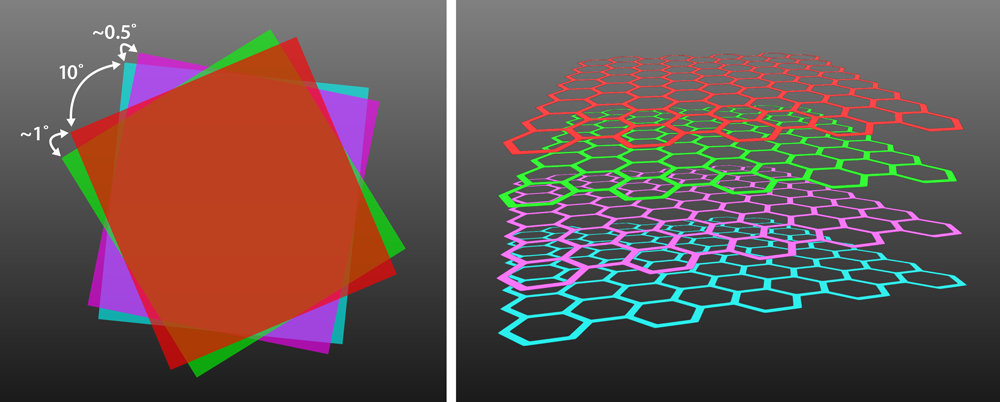
To help settle this debate, Barrier and colleagues stacked two TBGs, one with a superconductivity-inducing twist close to the magic angle, the other with a smaller (not magic) twist angle (Fig. 1). This second bilayer acted as a normal metal. By gating each bilayer separately, the researchers could induce different amounts of charge in each, allowing the metallic layer to screen electrons in the superconducting layer. To preserve their distinct electronic properties, the two TBGs had to be electronically decoupled so that their electronic states would not mix. In previous experiments, researchers achieved this decoupling using dielectric hexagonal boron nitride (h-BN) spacers, but these several-nanometer-thick layers weakened the screening effect. Instead, Barrier and colleagues introduced a 10° twist between the two TBGs. This ingenious trick decouples the two moiré patterns and suffices to keep their electronic states separate, avoiding the need for physical separation.
Engineering such screening is a good way to probe the pairing mechanism. In the Eliashberg theory of conventional superconductivity—a refinement of BCS theory—electrons experience an effective Coulomb repulsion * that must be overcome by an attraction mediated through the exchange of phonons. Increasing the screening between electrons lowers the repulsion * while leaving their phonon-mediated attraction unchanged. If TBG is a conventional superconductor, this screening effect should make phonon-induced electron pairing easier and raise the material’s T c. But this is exactly the opposite of what Barrier and colleagues observed. They found that increasing the screening between electrons in the superconducting TBG caused the superconducting phase to disappear. After ruling out trivial explanations, the researchers concluded that this disappearance offers strong evidence that TBG’s superconductivity arises from some type of correlated electron motion that is, at most, very weakly dependent on phonon-mediated attraction.
To model the observed behavior, Barrier and colleagues assumed that TBG’s superconductivity arises from an unconventional plasmon-mediated mechanism. Their basic argument is that, for the electronic states involved in superconductivity, screening efficiency decays exponentially on a scale of 2 nm. Because their device uses a large twist angle to decouple the two TBGs instead of a dielectric spacer, the interlayer separation is of subnanometer size, making screening maximally efficient, and much stronger than in earlier experiments with 3–10-nm h-BN spacer layers. Besides explaining the disappearance of the superconducting phase, this plasmon model could also explain an observed disappearance of correlated insulating phases at temperatures below 20 K.
While this simple level of modeling was all that can be afforded without massive computational effort owing to the complexity of the two-TBG system, it does provide a plausible pairing mechanism consistent with experiment. However, plasmon-based pairing is just one of the possible mechanisms behind unconventional superconductivity; other possibilities will need to be considered by theorists. The experiment by Barrier and colleagues is bound to produce another burst of activity on this topic.
And what about phonons? Is their fate sealed? There are indications that phonon modes might still help to stabilize the superconducting state, but this new experimental evidence makes it unlikely that they play a dominant role in electron pairing in TBG.
References
- Y. Cao et al., “Unconventional superconductivity in magic-angle graphene superlattices,” Nature 556, 43 (2018).
- J. Barrier et al., “Coulomb screening of superconductivity in magic-angle graphene,” Phys. Rev. X 16, 031040 (2026).
- R. Bistritzer and A. H. MacDonald, “Moiré bands in twisted double-layer graphene,” Proc. Natl. Acad. Sci. U.S.A. 108, 12233 (2011).
- G. Li et al., “Observation of Van Hove singularities in twisted graphene layers,” Nat. Phys. 6, 109 (2010).
- G. Sharma et al., “Superconductivity from collective excitations in magic-angle twisted bilayer graphene,” Phys. Rev. Res. 2, 022040 (2020); C. Lewandowski et al., “Pairing in magic-angle twisted bilayer graphene: Role of phonon and plasmon umklapp,” Phys. Rev. B 103, 235401 (2021); L. Peng et al., “Theoretical determination of the effect of a screening gate on plasmon-induced superconductivity in twisted bilayer graphene,” 109, 045404 (2024).
- E. Khalaf et al., “Charged skyrmions and topological origin of superconductivity in magic-angle graphene,” Sci. Adv. 7, eabf5299 (2021); Y. H. Kwan et al., “Skyrmions in twisted bilayer graphene: Stability, pairing, and crystallization,” Phys. Rev. X 12, 031020 (2022).
- J. González and T. Stauber, “Kohn-Luttinger superconductivity in twisted bilayer graphene,” Phys. Rev. Lett. 122, 026801 (2019); M. Long et al., “Evolution of superconductivity in twisted graphene multilayers,” Proc. Natl. Acad. Sci. U.S.A. 121, e2405259121 (2024).
- M. Christos et al., “Nodal band-off-diagonal superconductivity in twisted graphene superlattices,” Nat. Commun. 14, 7134 (2023).
- F. Wu et al., “Theory of phonon-mediated superconductivity in twisted bilayer graphene,” Phys. Rev. Lett. 121, 257001 (2018); Y. W. Choi and H. J. Choi, “Strong electron-phonon coupling, electron-hole asymmetry, and nonadiabaticity in magic-angle twisted bilayer graphene,” Phys. Rev. B 98, 241412 (2018); F. Wu et al., “Phonon-induced giant linear-in-T resistivity in magic angle twisted bilayer graphene: Ordinary strangeness and exotic superconductivity,” 99, 165112 (2019); B. Lian et al., “Twisted bilayer graphene: A phonon-driven superconductor,” Phys. Rev. Lett. 122, 257002 (2019).