


Bypassing the Speed Limit for Thermally Driven Demagnetization

The ability to control the spins of electrons has given rise to the field of spintronics, opening the door to faster, more energy-efficient electronics exploiting the spin degree of freedom of electrons rather than their electrical charge. However, controlling spin in real devices is still slower than controlling charge in conventional electronics. In the past 30 years, femtosecond light pulses have emerged as a promising means of rapid control in spin-based electronics. A magnetic material responds to external excitation most strongly when the system nears its phase-transition temperature. Unfortunately, that’s also where the response decelerates drastically—a phenomenon known as critical slowing down [1–3]. Now Yu-Han Gao at the Beijing National Laboratory for Condensed Matter Physics and colleagues have overcome this challenge with a clever materials design, achieving an accelerated response that could lead to faster spintronic devices [4].
The fact that spintronic speeds still lag behind those of conventional electronics may seem surprising, considering the tremendous advances to date in manipulating spins in ferromagnets on ultrashort timescales. In 1996, it was revealed that the magnetization state of a ferromagnet can be manipulated on subpicosecond timescales using femtosecond light pulses [5], giving rise to the field of femtomagnetism. In that seminal study, the magnetization state of a thin film of nickel was reduced by about 50%. Similar observations were subsequently made in other ferromagnetic materials, confirming the universality of the phenomenon [6]. Eleven years later, another landmark investigation showed that it is not only possible to destroy the magnetization in the ferrimagnet GdFeCo using light pulses but also to control its magnetization state [7]. The researchers used circularly polarized light, showing that the direction of the material’s magnetization state can be switched depending on the helicity of the light. The mechanism was dubbed helicity-dependent all-optical magnetization switching.
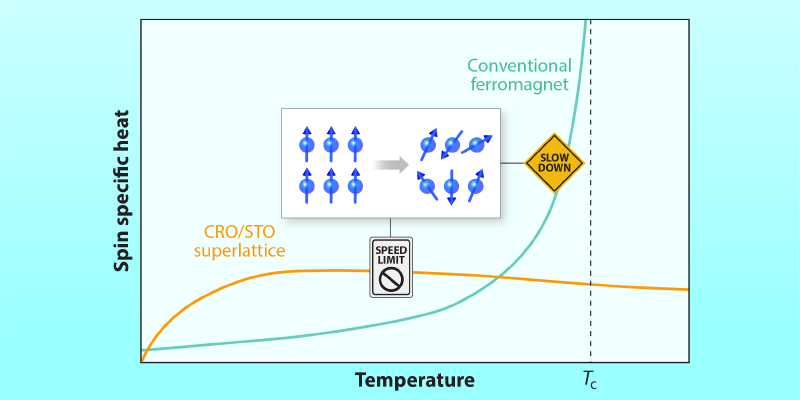
These discoveries highlighted the potential of femtosecond light pulses for controlling magnetism in spin-based electronics. However, realization of this potential requires an in-depth understanding of the underlying physical mechanisms governing a material’s response to light. Gao and colleagues’ work tackles key components of this endeavor: how to circumvent critical slowing down near the ferromagnet–paramagnet phase transition, where the spin specific heat diverges, causing a drastic increase in the energy needed to potentially maintain a constant rate of change in the materials’ magnetization state (Fig. 1).
The researchers used femtosecond light pulses to perform pump–probe experiments on superlattices made of alternating layers of CaRuO3 (CRO) and SrTiO3 (STO). They observed an anomalous acceleration in the superlattices’ demagnetization when they changed the temperature, the excitation fluence (the optical energy delivered per unit area by the laser pulse)—and even the external magnetic field. This acceleration arises owing to the peculiar nature of magnetism in their system. CRO and STO alone are not ferromagnetic, but the CRO/STO superlattice is a weak itinerant ferromagnet. The ferromagnetism appears at the interface between the materials because of a symmetry-mismatch-induced change in the Ru-O-Ru bond angles of CRO at the interface with STO. The interfacial ferromagnetic order decays away from the interface in the CRO layer, leading to a depth-dependent magnetization, which functions as the order parameter.
The depth dependence is the crucial ingredient in suppressing the divergence of the spin contribution to the specific heat, because the correlation length in the system cannot diverge the way it can in a spatially homogeneous system. In a conventional ferromagnet, the divergence of the spin specific heat near a phase transition suppresses spin relaxation, leading to critical slowing down. In the CRO/STO superlattice, this divergence is absent, allowing for significantly enhanced spin-flip scattering driven by strongly coupled thermal spin fluctuations, as described by the researchers’ model [4]. Experimentally, this manifests in a strong decrease in demagnetization time from about 1.2 picoseconds (ps) down to about 0.4 ps when the sample temperature is increased from 20 K to the critical temperature of 90 K. This behavior is in stark contrast to the typical behavior of simple ferromagnetic oxides like La0.3Sr0.7MnO3 or SrRuO3, in which the demagnetization time slows down dramatically upon approaching the phase transition [8].
The ability to control the demagnetization rate via temperature, laser fluence, and magnetic field gives multiple potential control knobs for spin dynamics. The strong sensitivity of ultrafast spin dynamics to moderate external magnetic fields in particular distinguishes CRO/STO from conventional ferromagnets: Previous predictions have suggested that, close to the phase transition, only extremely strong external fields (tens of tesla) can suppress the thermodynamic divergence of spin specific heat enough to modify these dynamics [9].
Gao and colleagues’ work thus marks an exciting new pathway for controlling ultrafast spin dynamics. However, some caveats apply. The system studied here is a weak itinerant ferromagnet, in which spin fluctuations play a major role in an extended temperature range. By contrast, for robust standard magnetic materials containing cobalt, iron, or nickel, such anomalous behavior may be expected only very close to the transition temperature. Furthermore, the fragility of magnetism in such a system may be challenging for future real-world devices, at least for those in which data retention for extended time periods is a design goal. And because oxide superlattices are challenging to manufacture, integration into devices will likely not be straightforward.
Where to go from here? As Gao and colleagues point out, the right path toward applications may involve finding designs for highly tunable ultrafast spintronics devices in which enhanced fluctuations are not a liability but an asset. This means forgoing ambitions to build memory devices and instead opting for switches, spin current sources, or detectors, potentially with operation speeds up to and beyond the 1-THz limit of the fastest charge-based devices [10]. From a fundamental physics point of view, it would be particularly exciting to see if Gao and colleagues’ approach could be used to bypass the macroscopic thermodynamic singularity in the spin specific heat in more conventional magnet–nonmagnet multilayer materials [11]. This achievement would make the approach more universal and better suited to spintronic applications.
References
- B. Koopmans et al., “Explaining the paradoxical diversity of ultrafast laser-induced demagnetization,” Nat. Mater. 9, 259 (2009).
- U. Atxitia et al., “Evidence for thermal mechanisms in laser-induced femtosecond spin dynamics,” Phys. Rev. B 81, 174401 (2010).
- J. Kimling et al., “Ultrafast demagnetization of FePt:Cu thin films and the role of magnetic heat capacity,” Phys. Rev. B 90, 224408 (2014).
- Y.-H. Gao et al., “Ultrafast demagnetization governed by spin fluctuations in CaRuO3/SrTiO3 superlattice,” Phys. Rev. Lett. 137, 126903 (2026).
- E. Beaurepaire et al., “Ultrafast spin dynamics in ferromagnetic nickel,” Phys. Rev. Lett. 76, 4250 (1996).
- A. Kirilyuk et al., “Ultrafast optical manipulation of magnetic order,” Rev. Mod. Phys. 82, 2731 (2010).
- C. D. Stanciu et al., “All-optical magnetic recording with circularly polarized light,” Phys. Rev. Lett. 99, 047601 (2007).
- T. Pincelli et al., “Transient quantum isolation and critical behavior in the magnetization dynamics of half-metallic manganites,” Phys. Rev. B 100, 045118 (2019).
- U. Atxitia, “Ultrafast magnetization dynamics at very high magnetic fields and elevated temperatures,” Phys. Rev. B 98, 014417 (2018).
- A. M. Arabhavi et al., “InP/GaAsSb double heterojunction bipolar transistor emitter-fin technology with fMAX = 1.2 THz,” IEEE Trans. Electron Devices 69, 2122 (2022).
- L. Fallarino et al., “Graded magnetic materials,” J. Phys. D: Appl. Phys. 54, 303002 (2021).