


Efficient Predictions of Electric Response
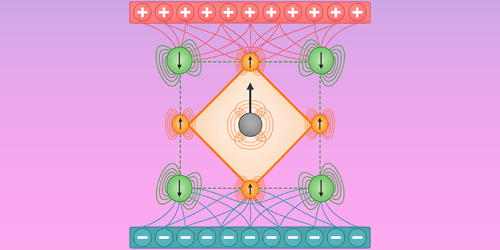

How materials respond to electric fields underpins technologies ranging from microelectronics to telecommunications. Unfortunately, predicting the properties that govern this response has long been computationally expensive. Now, in the inaugural issue of PRX Intelligence, Bradley Martin at University College London and his colleagues showcase a machine-learning model that can deliver efficient, accurate predictions for a broad range of inorganic crystals [1]. This capability could accelerate the discovery and optimization of new functional materials.
The researchers’ starting point was an existing machine-learning model that predicts properties of materials without accounting for external electric fields. They then incorporated such fields directly into the model’s architecture and trained the upgraded framework using data from quantum-mechanical calculations of electric response. These steps enabled the new model to learn a so-called electric-enthalpy functional, from which key quantities dictating electric response can be efficiently extracted. Such quantities are electric polarization, polarizability, and Born effective charges, which capture how atomic vibrations, lattice strain, and other motions redistribute charge.
In addition to accurately estimating these quantities, Martin and his colleagues’ model can accurately predict effects. These include how the polarization of the ferroelectric material barium titanate varies depending on the history of an applied electric field. The model can also reproduce the infrared, Raman, and dielectric spectra of the mineral quartz as predicted by theory. The researchers propose that their framework could be extended to electrolytes, geophysical materials in deep Earth, and other systems whose behavior is influenced by electric fields.
–Ryan Wilkinson
Ryan Wilkinson is a Corresponding Editor for Physics Magazine based in Durham, UK.
References
- B. A. A. Martin et al., “General learning of the electric response of inorganic materials,” PRX Intell. 1, 013006 (2026).