


What Network Structures Reveal About the Birds and the Bees
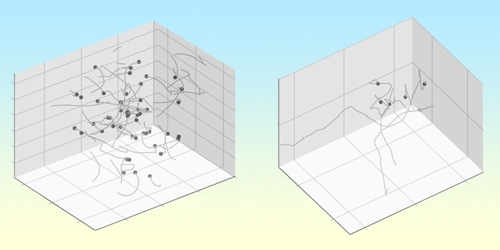

Many species of insects and birds move collectively without centralized coordination. The shapes and behaviors of these collectives vary across species and depend on factors such as environmental conditions and the animals’ intended task. Researchers would like to understand how these collectives emerge from interactions between individual animals and how their motion evolves in time. Now Ishriak Ahmed of Oklahoma State University and colleagues have gained insight into these processes by modeling groups of three different species as graph networks—collections of points (“nodes”) connected by lines (“edges”) [1].
The researchers studied images and videos of swarms of midges and honeybees (both insect species) and flocks of jackdaws (a bird species). Insects form more diffuse and disordered groups than birds. In addition, individuals of each type of animal interact differently. Midges form swarms by communicating with neighbors primarily acoustically, whereas honeybees and jackdaws use both acoustic and visual cues.
From their observations, Ahmed and colleagues mapped the 3D trajectories of individual animals in each collective. They modeled the individuals as nodes on a graph and interactions between them as edges. This graph representation allowed the researchers to calculate a statistical measure called Granger causality, which quantifies the effect that one individual has on the future trajectory of another. They found that jackdaws and honeybees interact with up to ten neighbors in their collective but, depending on the task, sometimes much fewer. Midges interact with four to six neighbors.
In the long term, the researchers intend to use their analyses of these animals to design robots that work in groups with decentralized communication and coordination strategies.
–Sophia Chen
Sophia Chen is a freelance science writer based in Columbus, Ohio.
References
- I. Ahmed et al., “From scattered to focused: Task-dependent connectivity in honey bees, with midge swarms and bird flocks,” Phys. Rev. E 113, 044403 (2026).