


How to Synchronize a Long-Distance Quantum Network
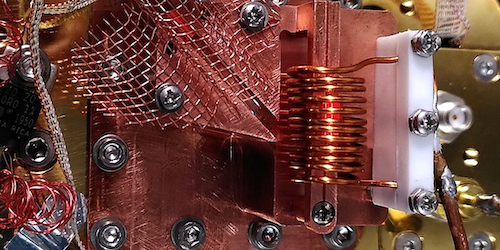

To sustain delicate light-based quantum states over a continental scale, fiber-based networks will need quantum repeaters. These devices rely on a protocol known as entanglement swapping, which iteratively transfers entanglement from one pair of photons to another pair in the next segment. This process requires each segment to be equipped with a quantum memory, and consecutive memories must be synchronized. Now Alberto E. Rodriguez-Moldes of the Institute of Photonic Sciences (ICFO) in Spain and colleagues have demonstrated a long-lived quantum memory that could enable synchronized operations in a network of widely separated nodes.
The ICFO team generated pairs of temporally correlated photons by exciting a nonlinear crystal in an optical cavity with a laser. In a quantum repeater, one photon encodes the quantum information and is stored locally in a quantum memory, while the other photon, known as a “heralding” photon, is transmitted to a distant central measuring station to confirm the creation of the stored photon. To work, the memory must store the photon for longer than the heralding photon’s travel time.
The team’s memory is based on a single crystal of praseodymium-doped yttrium orthosilicate (Pr:YSO). It can store a single photon’s quantum information for 180 microseconds, which suffices for nodes separated by up to 30 km. To achieve this duration, the team used a technique known as spin rephasing. A train of radio-frequency pulses inverted the populations of the two electronic states that store the photon’s information, thereby protecting it from environmental perturbations. Whereas previous studies have shown spin rephasing on classical light pulses, the team’s innovation was to demonstrate the technique on single photons.
–Sophia Chen
Sophia Chen is a freelance science writer based in Columbus, Ohio.
References
- A. E. Rodríguez-Moldes et al., “Long-lived telecom-heralded single-photon storage in an absorptive spin-rephased quantum memory,” Phys. Rev. Lett. 137, 120803 (2026).