


Solar Storm Unexpectedly Reduces Cosmic-Ray Flux
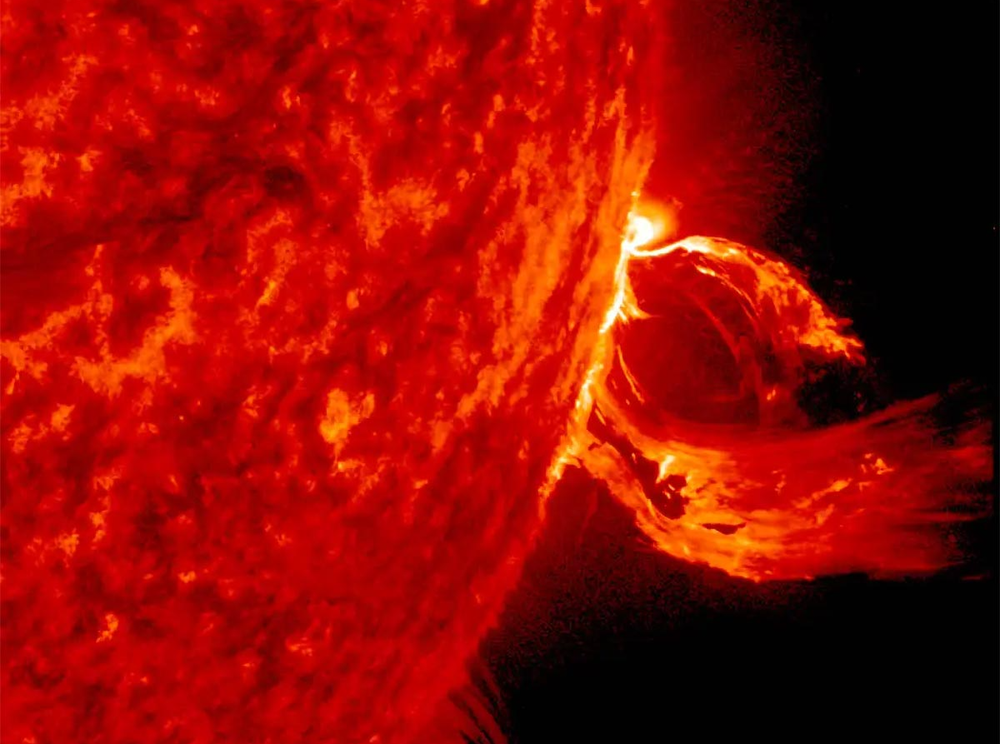

Solar activity has a well-known impact on the flux of low-energy cosmic rays that strike Earth. Now researchers have detected a solar-storm-induced change in the flux of higher-energy cosmic rays [1]. Using data from a large detector array in China, the team measured a decrease—over several hours—in cosmic-ray showers coming from a particular direction in the sky. The timing of this anisotropy suggests that cosmic rays heading into the outward-moving storm were preferentially scattered by the storm’s magnetic fields. The results could lead to a new way to study the magnetic structures in solar storms.
The solar wind—the spray of charged particles continually emitted by the Sun—partially shields Earth and other planets from cosmic rays that stream into the Solar System from all directions. The wind contains magnetic fields that help deflect the high-energy protons and other particles that make up the cosmic rays. In 2024, when the wind was at the peak in its 11-year cycle, the flux of cosmic rays was down by about 0.5% compared to the average.
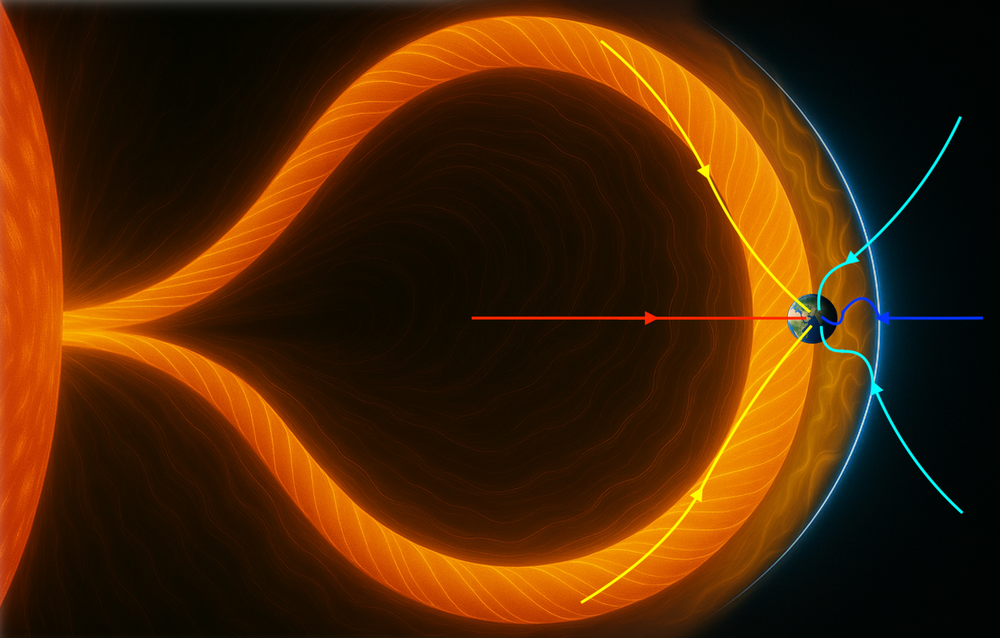
Such variation can also occur over daylong timescales when a solar storm passes over Earth. This spike in solar activity is often associated with a coronal mass ejection (CME)—a large bubble of plasma exploding from the Sun’s surface. In this plasma, magnetic field lines braided like the threads of a rope can trap cosmic rays, reducing the flux that reaches Earth by roughly 1%. This so-called Forbush decrease has been documented for relatively low-energy cosmic rays in the 100 MeV to 100 GeV range. At higher energies, cosmic rays should fly through the magnetic ropes, so their flux at Earth is expected to remain unaffected, says David Ruffolo of Mahidol University in Thailand.
To test this hypothesis, Ruffolo and his colleagues investigated the tera-electron-volt (TeV) cosmic-ray flux recorded by the Large High Altitude Air Shower Observatory (LHAASO) in China. The observatory consists of several types of detectors that collect secondary particles created when a cosmic ray crashes into the upper atmosphere. At TeV energies, LHAASO records several hundred million cosmic rays every hour. With such a high number of detections, Ruffolo and his colleagues—all members of the LHAASO Collaboration—were able to look for tiny variations during a solar storm.
Observing storm-induced variations in the TeV cosmic ray flux is difficult because atmospheric changes can cause relatively large variations from hour to hour. In light of this background noise, the researchers chose to look at changes in the pattern of arrival directions (anisotropy) of cosmic rays. Solar storms move out from the Sun and blow over Earth, potentially affecting cosmic rays in one part of the sky more than another. By contrast, atmospheric changes are more uniform, Ruffolo says, so they should not produce much noise in the anisotropy signal.
The researchers had at their disposal archival data that extended back to the summer of 2021, when LHAASO construction was completed. They chose as their target event a relatively strong CME that occurred on November 4, 2021. Over several hours on that day, they uncovered a relative decrease in the flux of cosmic rays coming from the northeast corner of the sky. This anisotropy signal reached a peak of 1.2%, according to an analysis by team members from the Purple Mountain Observatory in China.
The team’s explanation of the observations relies on a general model of the magnetic fields in a CME. The CME’s outward-moving bubble has smoothly varying magnetic fields that are unlikely to deflect TeV cosmic rays. However, there are magnetic fluctuations at the outer edge of the bubble. The team proposes that these fluctuations preferentially scatter cosmic rays that are moving inward, toward the Sun. And this scattering results in an anisotropy in the cosmic-ray pattern observed from Earth.
If this explanation is correct, then cosmic rays could offer an additional probe of CMEs and related storm phenomena. Much of our information about magnetic structures in solar storms comes from spacecraft, which make localized measurements. Cosmic rays sample a much larger region. “We can provide remote sensing along different cosmic-ray trajectories,” Ruffolo says. “We can learn something about the bigger picture of the distribution of these fluctuations.”
Space weather expert Sergio Dasso from the University of Buenos Aires in Argentina says the new work reinforces the view that ground-based cosmic-ray detectors complement spacecraft in mapping the plasma environment around the Sun. In his own work, Dasso has found evidence for storm-induced anisotropy at lower energies using the Pierre Auger Observatory [2]. “The new LHAASO observation successfully extends this physical sensitivity into the TeV regime,” he says.
–Michael Schirber
Michael Schirber is a Corresponding Editor for Physics Magazine based in Lyon, France.
References
- Z. Cao et al. (LHAASO Collaboration), “Transient large-scale anisotropy in TeV cosmic rays due to an interplanetary coronal mass ejection,” Phys. Rev. Lett. 136, 251002 (2026).
- S. Dasso et al., “Scaler mode in the Pierre Auger Observatory to study heliospheric modulation of cosmic rays,” Adv. Space Res. 49, 1563 (2012).